As the 2026 Summer Davos forum concluded in Dalian in late June, one phrase continued to echo across discussions on the future of the global economy: “Innovating at Scale.”
The theme of this year’s World Economic Forum Annual Meeting of the New Champions reflected more than technological ambition. It captured a deeper shift underway in the global economic landscape – one in which China is no longer simply participating in innovation-driven growth, but increasingly shaping its direction.
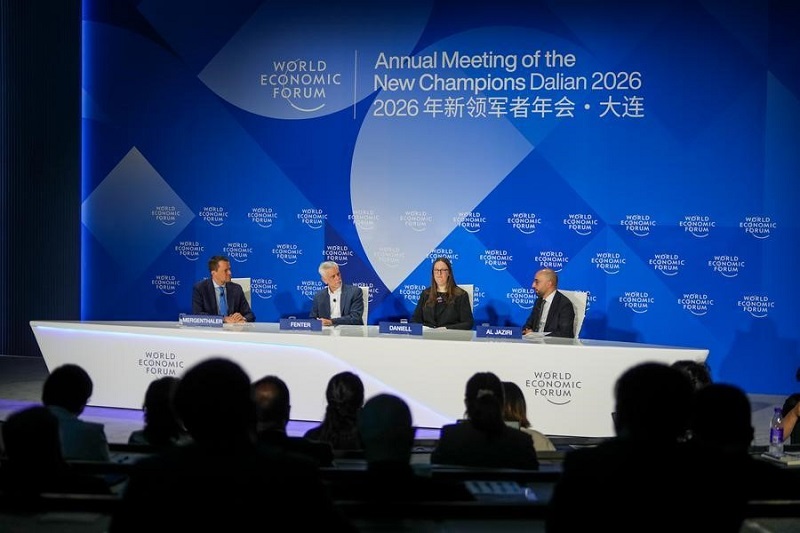
Participants attend a session titled "Top 10 Emerging Technologies 2026" during the 17th Annual Meeting of the New Champions in Dalian, northeast China's Liaoning Province, on June 23, 2026. (Xinhua/Xu Hongyan)
In an interview with China Today, James Weaver, an American independent financial consultant and former vice president of Chase Manhattan Bank’s Municipal Finance Division, argued that many Western business leaders still fundamentally misunderstand how China’s innovation ecosystem works – and why it has become such a powerful driver of global industrial transformation.
“People in the West often reduce China’s success to subsidies or state protection,” Weaver said. “But that interpretation misses the real dynamics inside the Chinese system.”
For Weaver, China’s rise in advanced manufacturing, clean energy, electric vehicles, digital infrastructure, and artificial intelligence reflects a unique combination of long-term strategic planning and fierce market competition.
“Innovating at Scale”: A New Model of Growth
According to Weaver, the phrase “innovating at scale” means something far more significant in China than simply producing large quantities of goods in modern factories. It entails tailored, innovative approaches to tackle systemic problems and challenges. “The scale of China precipitates innovation,” he explained.
Whether building nationwide high-speed rail networks, expanding renewable-energy grids, deploying AI applications, or commercializing electric vehicles, China has demonstrated an unusual ability to move technologies rapidly from experimentation to industrial deployment.
This is one of the defining features of the Chinese innovation model: the ability not only to invent technologies, but also to commercialize them quickly and integrate them into everyday economic life.
China’s electric vehicle industry offers a striking example. Chinese companies now account for a growing share of global EV production. Meanwhile, the country has built the world’s largest charging infrastructure network and developed highly competitive supply chains across battery materials, software systems, and smart manufacturing.
Weaver stressed that these advances are not simply the result of top-down industrial policy. “The breakthroughs happen at the company level,” he said. “The competition inside China is intense. Engineers, designers, and entrepreneurs are encouraged and rewarded to innovate faster and better.” This competitive environment, he argued, is often underestimated in Western boardrooms and policy crucibles.
Meanwhile, Weaver further interprets “scale” as expanding global partnerships: “Because I think one of the important opportunities emerging at the moment for North American, European, and Chinese business and industry are partnerships where technology and market access can be shared and solutions achieved globally.”
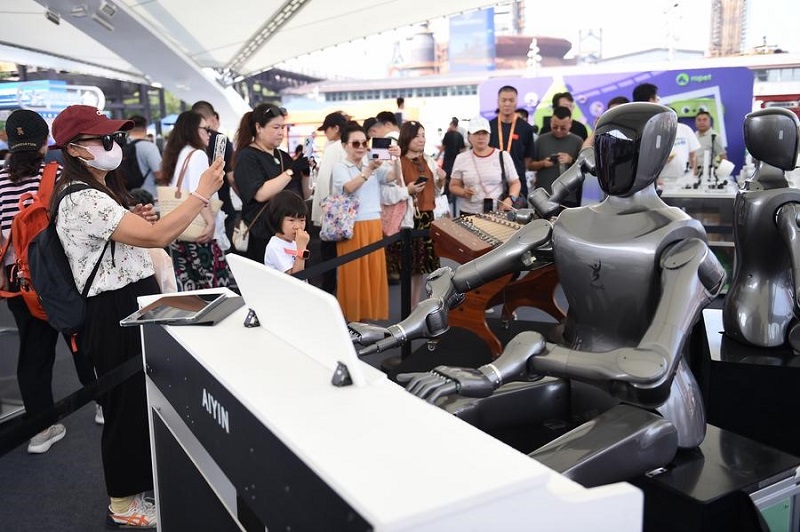
A humanoid robot plays piano at the 2025 China International Fair for Trade in Services (CIFTIS) in Beijing, capital of China, Sept. 11, 2025. (Xinhua/Liu Lingyi)
The Power of Long-Term Planning
One of the central themes of Weaver’s analysis about China was stability.
At a time when geopolitical tensions, policy uncertainty, and economic fragmentation are reshaping global markets, he believes China’s long-term planning system has become a major competitive advantage.
“Uncertainty creates risk,” Weaver noted. “And businesses globally are now operating in a much more unstable environment.”
In contrast, he pointed to China’s consistent policy direction through successive five-year plans, which provide investors and industries with long-term strategic signals.
“Major themes are carried from one plan into the next,” he said. “That creates continuity.”
China’s emphasis on advanced manufacturing, green development, technological upgrading, and industrial modernization has remained remarkably consistent over the past decade. The newly launched 15th Five-Year Plan (2026-2030) continues to prioritize innovation-driven growth, clean energy, digital transformation, and high-quality development.
This long-term policy orientation differs sharply from what Weaver described as the increasingly short-term political cycles dominating many Western economies.
“The Chinese leadership tends to think in decades,” he said. “In much of the West, policy often changes, even radically, with elections, and is designed to please powerful interest groups rather than to serve the long-term public good.”
That consistency, he argued, gives companies greater confidence when making long-term investments in technology, infrastructure, and industrial capacity.
Planning at the Top, Competing at the Bottom
Weaver believes one of the biggest Western misconceptions about China is that the government controls every aspect of economic activity.
“That’s simply not how the system works,” he said.
Instead, he compared the Chinese government’s role to that of a corporate board of directors: setting broad strategic goals while leaving operational decisions and responsibility to achieve goals to companies themselves.
“The board sets priorities and direction,” Weaver explained. “But management determines how to compete and succeed.”
This structure has produced what he sees as a uniquely effective hybrid model – combining state coordination at the macro level with highly competitive market dynamics at the micro level. Economists increasingly recognize this combination as one of the key drivers behind China’s rapid ascent up the global value chain.
The country’s investment in education and engineering talent has also played a critical role. China graduates millions of students in science, technology, engineering, and mathematics annually, while universities increasingly collaborate with industrial partners on research commercialization.
“China’s system rewards technical competence,” Weaver said. “That has become a major source of industrial strength.”
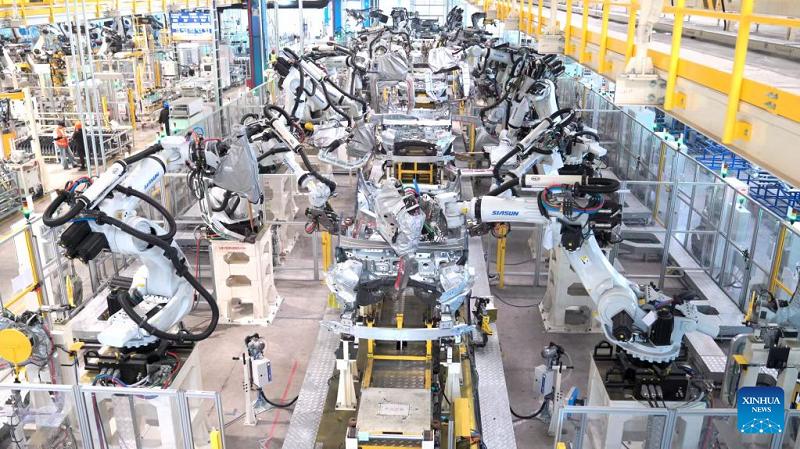
This photo taken in April 2026 shows arc welding robots produced by Siasun Robot & Automation Co., Ltd. working at the welding workshop of Geely's new energy vehicle (NEV) manufacturing plant in Yiwu, east China's Zhejiang Province. (Xinhua)
Greening as Industrial Logic, Not Just Climate Policy
Nowhere is China’s innovation model more visible than in its green transition.
China is already the world’s largest producer of solar panels, wind turbines, batteries, and electric vehicles. It has also built one of the world’s most extensive renewable-energy infrastructures.
For Weaver, China’s green transition differs significantly from approaches taken elsewhere.
“In some countries, green transition is driven mainly by politics,” he observed. “In China, it has become part of a broader long-term industrial and economic strategy.”
This approach aligns closely with China’s long-term climate and development policies. As outlined in the Chinese government’s white paper Responding to Climate Change: China’s Policies and Actions, the country has integrated carbon reduction and green transformation into its overall modernization strategy. China aims to peak carbon emissions before 2030 and achieve carbon neutrality before 2060, while simultaneously building what policymakers describe as a modernized country in which humanity and nature coexist in harmony. The scale of this transformation is already reshaping global energy markets.
Weaver noted that China’s rapid electrification and renewable-energy expansion have made its economy increasingly resilient to oil-price volatility. “China’s transition away from fossil fuels has reduced vulnerability in ways many people did not anticipate,” he said.
At the same time, China’s green technologies are creating new opportunities for international cooperation. Warwick Powell, an adjunct professor at Queensland University of Technology in Australia, recently argued that China’s push into green hydrogen, batteries, and renewable infrastructure could deepen industrial cooperation with countries such as Australia. “By aligning policies, Australia could benefit from technology transfers and market access,” Powell told China Daily, emphasizing the potential for joint ventures in clean technology and advanced manufacturing.
For Weaver, such partnerships represent the next phase of globalization. “Technology sharing and industrial cooperation are going to become increasingly important,” he said. “There are enormous opportunities if countries are willing to engage pragmatically.”
Changing Perceptions
Weaver also addressed persistent Western concerns over intellectual property protection in China. While acknowledging historical problems, he argued that the global technology landscape has shifted significantly. “China now generates more intellectual property than almost any other country,” he said. “Increasingly, the flow of technology is moving outward from China.”
Indeed, Chinese companies have become global leaders in sectors ranging from telecommunications and battery technology to e-commerce and renewable energy systems.
This shift is forcing many multinational companies to rethink assumptions that once dominated discussions about China.
According to Weaver, however, political concerns still remain one of the greatest obstacles to deeper and broader cooperation. “The commercial opportunities are there,” he said. “Businesses can see them clearly.” Despite current geopolitical frictions, Weaver believes economic logic will continue pushing global industries toward engagement with China.
“There is simply too much innovation, too much industrial capacity, and too much technological advancement here to ignore in the commercial, economic, and eventually political spheres,” he said.
As global growth slows and uncertainty increases elsewhere, China’s combination of strategic planning, industrial scale, technological ambition, and market competition is increasingly emerging as one of the defining economic models of the 21st century.
And for many international investors and businesses, understanding that model may become less optional – and more essential.