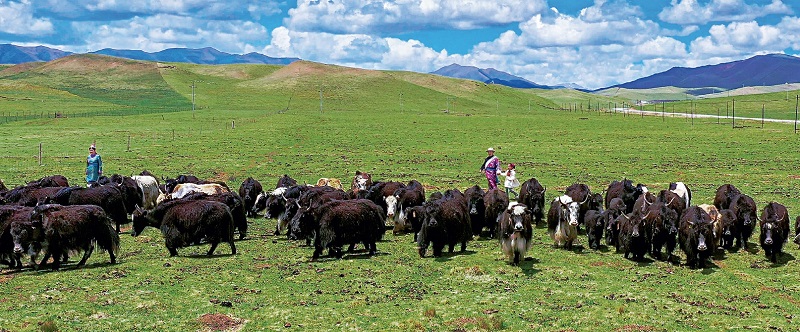
Snow-capped mountains tower over vast alpine meadows where herds of cattle and sheep graze under the watchful care of herders in Haibei Tibetan Autonomous Prefecture, northwest China’s Qinghai Province.
Haibei Tibetan Autonomous Prefecture, in northwest China’s Qinghai Province, is often associated with towering snow-capped mountains, vast swathes of grassland, and sprawling herds of cattle and sheep. However, today, this traditionally pastoral plateau is increasingly becoming connected to the national market through an ever expanding industrial chain. From a carton of milk and a mutton chop, to a bottle of rapeseed oil and a bag of highland barley flour, Haibei is exploring a path of high-quality development prioritizing ecological conservation, led by science and technology, and driven by innovation.
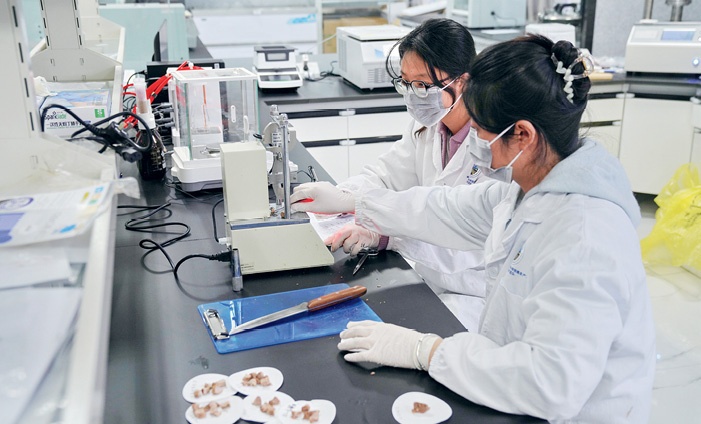
Researchers at the Qilian Tibetan Sheep Industry Development Research Institute conduct laboratory testing and experiments.
A Plateau County’s Industrial Breakthrough
In the past, industrial enterprises in Qilian County, Haibei, were mostly scattered across townships, with small processing plants, incomplete facilities, and heavy environmental pollution. They faced limited room for growth and found it difficult to achieve economies of scale.
The turning point came with the systematic development of an industrial park. In 2009, the establishment of the Qilian Ecological Industrial Concentrated Development Zone was approved. It became an important platform for the concentrated development of the county’s industry.
“The park is not simply about bringing enterprises together; it is about enabling industries to develop synergy,” said Qin Bingfeng, deputy director of the administration committee of industrial park. The park has made processing of green and organic agricultural and livestock products its leading industry, while also planning for feed processing, clean energy, incubation of small and micro enterprises, and modern producer services. It strictly excludes high-energy-consuming projects that produce pollution, safeguarding ecological protection and high-quality development throughout the production chain.
This development philosophy has greatly helped a number of enterprises rooted in local resources to gradually grow stronger. The park has also evolved from a mere space for industrial development into an important platform for promoting coordinated development along the industrial chain.
Inside the production workshop of Qinghai Qianhu Mulyu Company located in Qilian County, cold-chain equipment is running continuously as workers orderly cut, weigh, and package Tibetan mutton. “The platform and supporting conditions provided by the industrial park have greatly helped our company grow to its current scale,” said Yedan Dorje, the company’s CEO. Stable land supply, well-developed infrastructure, and the benefits of industrial agglomeration have enabled the company to devote more energy to product quality and market expansion.
With the support of the park, as its production capacity and market reach continue to expand, the company has begun exploring new ways to grow, striving to extend its industrial chain while preserving the roots and essence of grassland culture.
“We have always wanted to build a truly locally-operated enterprise,” said Dorje. “‘Qianhu’ in the name of our company (literally meaning ‘a thousand households’) originates from nomadic culture, symbolizing each family’s role in safeguarding the grassland. It also reminds us not to lose the authenticity of the grassland.” By introducing chilled meat cutting technology, the company has effectively overcome the limitations on the transportation radius of meat products in high-altitude regions, allowing stable supplies to reach places, such as east China’s Shandong Province, northwest China’s Xinjiang Uygur Autonomous Region, and southwest China’s Xizang Autonomous Region. Meanwhile, the company connects directly with consumers on Douyin, the Chinese version of TikTok, gradually expanding its online sales channels.
The Chinese government pledged in its 2026 report on its work delivered to the National People’s Congress in March that efforts will be made to advance the deep integration of culture and tourism, foster new cultural and tourism models with distinctive regional characteristics, and promote sustained growth in cultural and tourism consumption.
Immersive experiences and cultural consumption scenarios centered on grassland culture are now creating new opportunities for integrated industrial development in plateau regions. Building on this, Qianhu Mulyu is also planning more diversified development pathways. “Our next step is to truly integrate grassland culture into industrial development,” said Dorje.
“We don’t just want to sell products. Instead, we hope that more people will come to know Qilian and understand the grassland through our products,” he added.
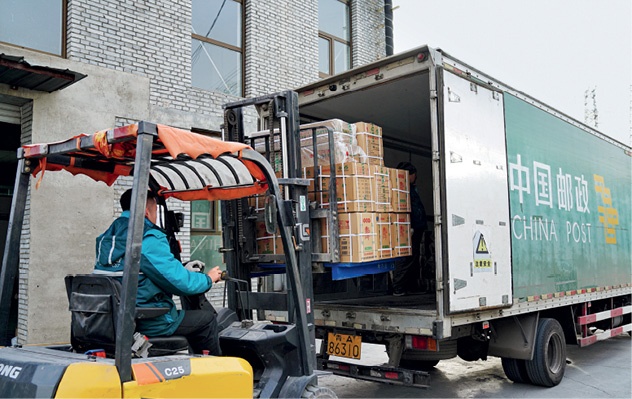
Rapeseed oil produced in Menyuan County is delivered by China Post to customers across China.
Sheep Farming Now an Entire Industrial Chain
In Haibei, animal husbandry has long been an important industry supporting county-level economies and increasing herders’ incomes. Revitalizing this “traditional industry” amid ecological changes and shifting market dynamics has become a central question in promoting high-quality development in Haibei. In Qilian County, Tibetan sheep are gradually embodying the tangible promise of technology-empowered transformation and upgrading in animal husbandry.
To break the bottlenecks in traditional animal husbandry development, Qilian County requires systematic technological support and long-term investment. Doing this means Qilian County has prioritized scientific and technological innovation, using research capacity to drive industrial upgrading.
In 2024, the Qilian Tibetan Sheep Industry Development Research Institute was officially established. Focusing on the core needs of high-altitude pastoral development, it has set up multiple research directions, including veterinary medicine, animal science, and grassland science. Experts and scholars from higher education institutions, such as Qinghai University and Gansu Agricultural University, together with local animal husbandry technicians, have formed joint research teams, promoting deep integration of industry, academia, and research.
“Scientific research cannot solve problems in pastoral areas if it remains confined to the laboratory,” said Ren Yaxiong, a technician at the research institute. According to Ren, research teams have been stationed in pastoral areas for a long time, collaborating with cooperatives and family ranches on joint projects. By moving the laboratory to grasslands and sheep pens, “every practical problem encountered by herders becomes the starting point of our research,” Ren said.
As scientific expertise reaches the front lines, a range of technologies suited to high-altitude pastoral areas are being set up.
“We couldn’t imagine achieving this before,” said a herder participating in the pilot program. He told China Today that in the past, Tibetan sheep had long breeding cycles and unstable survival rates. Now, with technical guidance, reproduction rates are on the increase, and the herd structure more balanced. “With a larger quantity and higher quality of sheep, incomes naturally go up, and people feel much more secure,” he said.
The research institute has not limited itself to technological breakthroughs, but focused on the key constraints facing the development of animal husbandry. Presently, the research team is carrying out a research agenda in areas such as infectious disease prevention and control, meat quality improvement, genetic selection, and supplementary feeding during the withering period. In addition, the research institute maintains long-term exchanges and cooperation with higher education institutions and other organizations across different regions, introducing cutting-edge international concepts while tailoring them to the realities of high-altitude pastoral areas. These include ecological fragility and dispersed farming practices, along with exploring technological pathways that can be rolled out elsewhere.
“Many types of data cannot be estimated. They have to be verified sheep by sheep,” explained Ren. The team has conducted systematic experiments on 200 to 300 Tibetan sheep for related research topics. “These seemingly ‘old-fashioned’ methods are actually essential for obtaining the most accurate and reliable data, ensuring that once technologies are applied, herders can truly use them with confidence,” Ren added.
As research outcomes continue to become practical applications, the Tibetan sheep industry in Qilian is undergoing a profound transformation. The brand recognition and market acceptance of “Qilian sheep” is steadily rising. This has not only strengthened herders’ confidence in breed conservation and scientific farming, but also laid a solid foundation for downstream deep processing and market development. Technology is paving the way toward a more stable and sustainable path for the development of animal husbandry on the plateau.
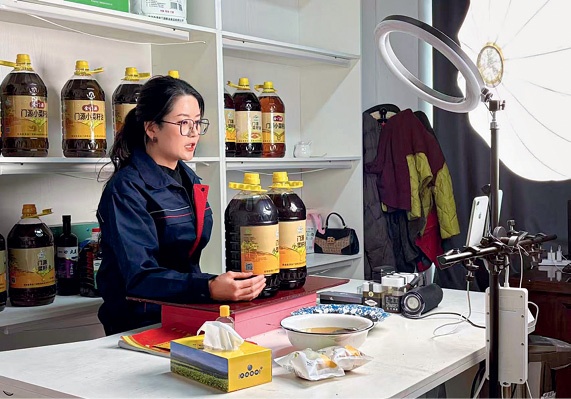
Livestreaming helps agricultural products reach a broader market.
 From Rapeseed Blossoms to Livestream Rooms
Every midsummer, vast stretches of rapeseed flowers bloom across Menyuan Hui Autonomous County in Haibei. The “golden sea of flowers” captured by endless tourists’ cameras is not only a beautiful landscape but also has gradually become an important starting point for the local push toward agricultural transformation and upgrading.
The Chinese central government called for enriching cultural and tourism consumption scenarios, fostering new business models such as rural and eco-tourism. Menyuan has been continuously exploring how to transform “visible landscapes” into “exportable industries.”
To make this dream a reality, a group of local enterprises from the rapeseed industry began moving beyond basic primary processing toward broader market opportunities.
“We started with learning oil pressing step by step,” recalled Zhang Hailong, head of Qinghai Xiangmanjin Menyuan Grain and Oil Food Co., Ltd. In 1995, the company was still a small-scale, workshop-style operation. It was not until 2010 that it built its first standardized oil-processing plant. “At that time, our goal was simple: produce good oil and sell it,” Zhang said. What truly reshaped the company’s development trajectory was the subsequent rise of e-commerce.
The limitations of traditional processing models, including being restricted by geography and distribution channels, forced the company to look for opportunities elsewhere. Coincidentally, Menyuan had been actively exploring the possibilities of the “agriculture + internet” model, opening up broader market space for local businesses.
In 2015, Zhang traveled to Hangzhou for e-commerce training. “That experience had a profound impact on me,” he recalled. “After coming back, I truly realized that highland agricultural products don’t have to ‘wait for customers to come.’ They can actively reach out to customers wherever they are.” Gradually, the company began experimenting with selling highland rapeseed oil through livestreaming. Soon, they expanded across platforms, such as Douyin, Kuaishou, JD.com, and WeChat Channels, making livestream sales a regular practice. Daily revenue from livestreaming has stabilized at between RMB 40,000 to 50,000.
The rapid growth in online sales allowed the company to taste the dividends of digital transformation, but new hurdles soon emerged. Rapeseed oil production is highly dependent on the planting area and seasonality, and the company lacked product diversification. The company’s new challenge became how to extend the industrial chain while maintaining their core business.
“Later, we turned our eyes to highland barley,” Zhang said. Leveraging Menyuan’s plateau climate and its advantage in high-quality raw materials, Zhang’s comany began extending its business into the deep processing of highland barley, successively developing a range of organic products, including highland barley noodles, barley rice, barley flour, and barley cakes.
“Experience alone is not enough. We want to make our products more standardized and healthier,” Zhang said. To this end, his company has partnered with research institutions such as the Shandong Academy of Agricultural Sciences and the COFCO Nutrition and Health Research Institute, introducing professional technologies to enhance scientific content and product stability.
Behind these continued “breakthroughs” lies the profound transformation of traditional agriculture into a modern industrial system, assisted by the company’s repeated rounds of self-upgrading amid market transformation.
Today, the company’s highland barley products are sold in Shandong, Shaanxi, Shanghai, Zhejiang, and other places. Online sales account for 40 percent of the total revenue, with the offline market covering multiple provinces, including Qinghai and Gansu. “Our next step is to bring Menyuan’s good raw materials and quality products to an even larger market,” Zhang said.
Haibei’s industrial development has forged a development path tailored to local conditions and guided by ecological conservation. From laying solid foundations in industrial parks, to technological breakthroughs by research institutes, and then to practical implementation across pastoral grasslands, the story of green, intensive, and sustainable development on this vast plateau continues to unfold. “Industrial development does not happen overnight, but if the direction is right, progress can be steady and far-reaching,” Qin Bingfeng said.