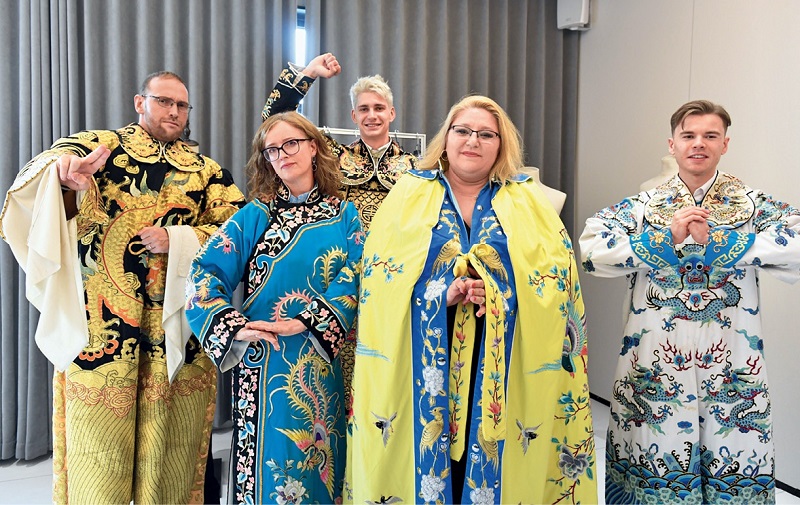
Sander Kole (first from the left) dresses up in the traditional costume of Peking Opera in Beijing, on October 23, 2025.
Sander Kole, a video creator born in the Netherlands, has become a superstar influencer on social media, connecting Chinese and European cultures. With almost 20 million followers on platforms like TikTok, YouTube, Douyin, Xiaohongshu, and WeChat, he uses short videos to show European audiences real life stories in China.
Making a Life in China
When Kole settled in Shenzhen, southeast China’s Guangdong Province back in 2001 at the age of seven with his family, the city’s skyline was far from the concrete jungle it is today. Following his father who worked in China, he traveled 8,000 kilometers from a small Dutch town to this southern metropolis where Cantonese and Mandarin languages interweave, and tradition collides with modernity. For the young boy, Shenzhen was not just a geographical relocation, but a deep immersion into a new culture.
“I started visiting Shenzhen frequently from the age of three,” Kole told China Today. “Each trip filled me with joy and excitement! It’s a city bursting with energy, and every visit brought me something new to discover.” After nearly two decades in Shenzhen, Kole now speaks fluent Chinese, and has gained a deeper understanding of local culture and formed many lasting friendships. After graduating from high school in the Netherlands, he chose to stay in China to help out in his father’s company.
When his father returned to the Netherlands for work in 2017, Kole made a pivotal decision – to stay in Shenzhen, take up his camera, and start documenting the China he experienced. What began as casual filming by an avid video enthusiast, gradually unfolded into a distinct perspective: that of an “insider” who understands the culture intimately, yet retains the observant eye of an “outsider.” The China through his lens featured both the bustle of everyday life and the serenity of cultural reflection. This subtle balance between the two became the most precious asset for his future creations.
In 2020, Kole returned to the Netherlands for a family reunion but experienced a culture shock in his home country after so many years away. He realized that in the minds of his countryfolk China remained a distant unknown place.
“Some hold preconceived opinions, while others know almost nothing,” Kole acknowledged. “It made me truly regretful, and also made me realize I might be able to help build a bridge between China and Europe.”
Kole said that rather than relying on existing media narratives, he hopes to share the authentic China he has personally witnessed with European audiences. To achieve this, he decided to draw on his videography skills and leverage social media platforms to launch short video series centered on China, using vivid imagery to tell the stories.
His lens captures a wide range of themes such as street interviews documenting the lives of ordinary people, firsthand experiences of food delivery services that showcase urban conveniences, and exploring traditional festivals, culinary culture, and technological innovations. “I’m not trying to prove anything to anyone,” he emphasized. “I simply want Europeans to see that China is actually a vibrant, open, and diverse country.”
The Power of Cross-Cultural Storytelling
What makes Kole’s work widely popular across many European countries and equally cherished by Chinese viewers can be summed up in one word: “authenticity.” This encompasses both the truthfulness of his content and the sincerity of his commentary. In his videos, China is not treated as something to be “proven” or “defended,” but rather as a living, evolving reality to be “seen” and “understood.”
This creative philosophy finds an even deeper expression in the music project he initiated. In early 2025, Kole spearheaded the production of the song UNIT 731, created and performed by the British singer-songwriter Tim Moyo. It is the first-ever English-language song to expose the atrocities committed by the Japanese Unit 731 during World War II. Adopting a first-person perspective, the song transforms that deliberately obscured historical violence into an unforgettable artistic testament.
“By blending Tim Moyo’s haunting vocals with meticulously researched lyrics, we hope to ignite conversation and ensure this history is not just remembered, but deeply felt,” Kole said.
The song quickly went viral on global social media platforms, amassing 250 million streams and 16 million likes within days. It also soared to the top of the charts on NetEase Cloud Music and QQ Music simultaneously. This achievement is remarkable – it demonstrates that stories rooted in China’s history can transcend linguistic and geographical barriers, resonating deep within our shared humanity.
“Growing up straddling two worlds, I learned that the most powerful stories are neither Eastern nor Western – they are human.” These words capture the essence of Kole’s creative philosophy. The Internet allows him to share these stories on a global scale, turning cross-cultural understanding from a slogan into a shared journey that millions can travel every day.
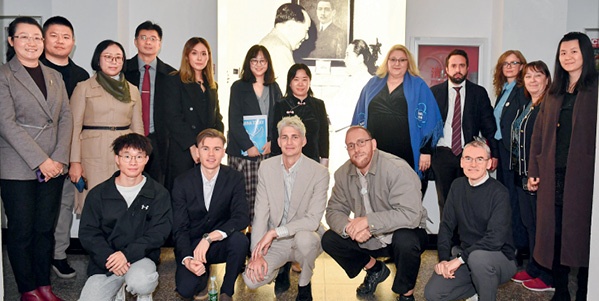
Sander Kole (second from the right, front row) joins a group photo during his visit to the Center for Europe and Africa (China Today) under the China International Communications Group in Beijing, on October 23, 2025.
Music: A Magical Key Connecting Cultures
“When talking about Chinese music taking the world by storm this year, one cannot overlook Chinese rapper Lanlao’s (also known as SKAI ISYOURGOD) tracks like Da Zhan Hong Tu (Blueprint Supreme) and Ba Fang Lai Cai (Stacks from All Sides),” Kole said with palpable excitement. Since February last year, these works, which blend Cantonese dialect, Lingnan culture roots, and Memphis rap style, have ignited a viral wave across Douyin and TikTok, platforms where users share short videos and live streams enhanced with creative effects, sounds, and music. The Da Zhan Hong Tu hashtag has garnered over 4.3 billion plays, and Ba Fang Lai Cai over 6.6 billion plays. Countless international netizens have since used these songs as the soundtrack for their travel vlogs and China-themed short videos.
What struck Kole most was a Swiss influencer, with over 5.3 million followers, who posted his own Chinese cover of Da Zhan Hong Tu. And when he and his friends drove straight from the Netherlands to Paris to watch Lanlao’s live show, the scene that unfolded was even more astonishing – over 500 fans packed the venue, with nearly half coming from outside China. For most of the 15 songs performed, the entire audience sang along in unison.
“Some fans, even without speaking Chinese, were drawn to the Memphis-style rap blended with Chinese musical elements. Others love the blessings in Ba Fang Lai Cai and will shout ‘Lai Cai’ – meaning “bring in wealth” in Chinese during the chorus. Many had even put together their own playlists of Chinese songs and listen to them regularly... Everyone said they would keep exploring Chinese culture and music,” Kole recalled, still vividly moved by the memory.
The power of music lies in its ability to bypass language’s rational defenses and strike directly at the heart of emotional resonance. Just as Da Zhan Hong Tu implants Cantonese dialect and Lingnan culture roots into its lyrics, incorporating creative expressions from traditional opera, Kole has also invited international musicians to blend Chinese symbols like the Great Wall and Shaolin Kung Fu into their works, describing Chinese people as “kind and generous,” whose “hospitality is always sincere and open.”
Kole has also produced a video series titled “Asking International Musicians to Write Songs About China.” He firmly believes that music can serve as a window to deepen mutual understanding between China and the West. Guided by him, musicians who have never visited China first compose a song based on their imagination and perception of the country, which is then filmed into a music video. Afterwards, Kole personally takes them on a field trip to China, inviting them to create a second piece after the experience. “It’s both fascinating and deeply meaningful to see how their creative output evolves once they’ve actually set foot in China,” he said.
A Two-Way Cultural Journey
If online content is the virtual bridge Kole has built, then offline field visits are the tangible pathways he has opened. He firmly believes that, “To truly understand China, you cannot rely solely on the Internet. You must go there in person to truly feel the pulse of this country.”
Since 2024, he began inviting friends from abroad, especially those who had never visited China, to accompany him on trips around the country. Watching their reactions upon first stepping onto Chinese soil, he observed, “It’s a sense of pure curiosity and wonder.” That genuine, unscripted feeling often proves more convincing than any meticulously crafted promotional video.
Dutch content creator Quentin traveled to China for filming at Kole’s invitation. After returning from the trip, this popular European influencer made a decision – to commit to weekly Chinese language lessons. “China is too fascinating. Learning Chinese well is essential if I want to truly understand the country,” Quentin said.
This year, Kole’s efforts gained more recognition. His short video work claimed the top prize in the themed creative competition “50 Years of China-Europe Relations, Hand in Hand Towards the Future.” For a content creator long rooted in China and dedicated to telling China’s stories with European audiences, this honor is not only an affirmation but also a meaningful encouragement.
“I have lived in Shenzhen for nearly 20 years; China is truly my second home. As a short video creator, I have always hoped to use imagery to tell Chinese stories. I will continue to document my personal experiences here, using images to build a bridge for communication and exchange.” He expressed genuine warmth at being regarded as a young “cultural ambassador.”
Cultural exchange is never simple, yet Kole has built a bridge in his own way – one that flows in both directions. Through his work, Europeans encounter an authentic China, while Chinese audiences perceive an open and engaging world beyond. In the digital age, he has demonstrated through short videos and music that the heart of cross-cultural understanding lies not in erasing differences, but in recognizing the shared humanity within them.