The Orchid Awards honor people who build bridges between civilizations. In early September, some of the very people who do that work were given a bridge of their own to walk across.
From September 7 to 12, around two dozen Orchid Awards candidates and jury members from the U.S., the U.K., Italy, Germany, the Netherlands, Japan, Thailand, Cambodia, Brazil, Syria, Lebanon, and Mali explored the millennia-old cities of Xi’an and Hanzhong in Shaanxi Province on a 6-day tour which was a sideline activity of the Orchid Awards. They came as scholars, historians, artists, photographers, technologists and storytellers. What they found was a province that refuses to choose between its past and its future.
Initiated by China International Communications Group (CICG), the Orchid Awards recognize foreign individuals and organizations worldwide that have made sustained contributions to international cultural exchange and mutual learning among civilizations.
The Third Orchid Awards Jury Meeting was held in Beijing on September 6 and the Orchid Awards ceremony is scheduled to be held in October in Beijing.
The itinerary that followed was not sightseeing. It was the awards’ premise, put into practice.
Where the Past Is Still Present
Tour participants immersed themselves in Xi’an’s rich traditional cultural vibe at the Xi’an Museum, the Longest Day in Chang’an Theme Block, and the UNESCO World Heritage Emperor Qinshihuang’s Mausoleum Site Museum on September 7-9.
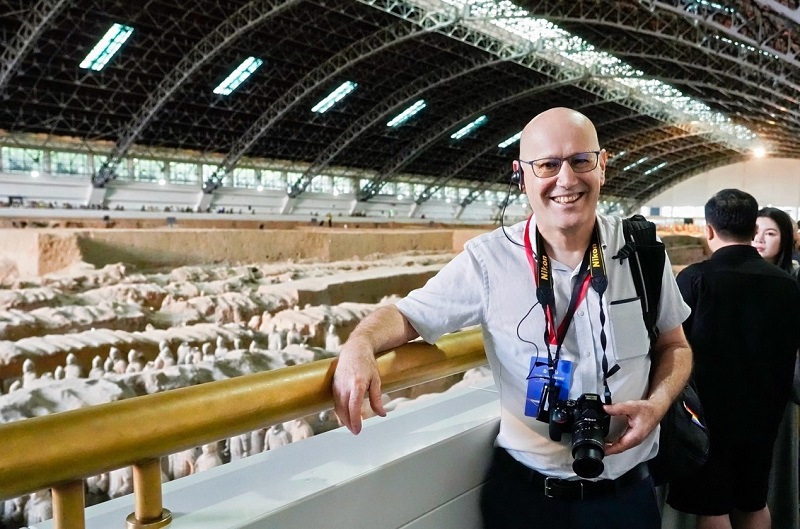
American historian Peter Brian Ditmanson poses for a photo at the site of the Terracotta Warriors at the Emperor Qinshihuang's Mausoleum Site Museum on September 9, 2026.
American historian Peter Brian Ditmanson, professor at Yuelu Academy, central China’s Hunan University, said this is his third visit to Xi’an, and he has seen huge improvements in transportation and accommodation since his first trip here almost 40 years ago.
At the site of Qin Shihuang’s Terracotta Warriors, Ditmanson told China Today that the exhibition of cultural relics plays an important role not only in understanding history but also in promoting international cultural exchange. China’s experience in preserving culture heritage can provide valuable examples for the rest of the world, particularly in terms of the technology and methods of conservation, and ways of communicating historical information to the public, he added.
“Xi’an reminds me of a city in my home country named Aleppo,” said Syrian professor Rasha Khalil at the School of Business English, Sichuan International Studies University (SISU). Though the two places are located thousands of miles away from each other, both cities are ancient cities, sit at the ends of the ancient silk road, and have been shaped by travelers and traders, therefore connected in a way.
From September 10, the tour moved south to Hanzhong, a name familiar to anyone who knows the Three Kingdoms period (220–280). Nestled among hills in southern Shaanxi, the city was a military and political base of the state of Shu and the stage for many of that era’s decisive events. The group visited the Hanzhong Museum, renowned for its collection of stone inscriptions recording the ancient plank roads, as well as the shrine and tomb of Zhuge Liang, the revered Shu statesman, and the memorial hall of Zhang Qian, the Han Dynasty diplomat whose missions opened the overland Silk Road and who was born and buried here.
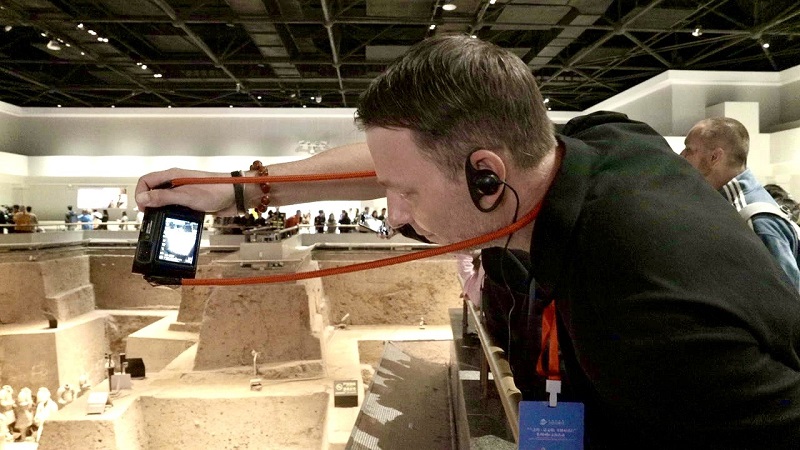
Claus Trojahn, a photographer from Germany, take photos of the Terracotta Warriors at the Emperor Qinshihuang's Mausoleum Site Museum on September 9, 2026.
“I drew a lot of inspiration from these experiences for my photography work,” said Claus Trojahn, a photographer from Germany. This was his first time visiting Xi’an and Hanzhong. He was amazed by the rich history and historic artifacts displayed in the museums, and loved local specialties like roujiamo (a Xi’an-style meat-stuffed flatbread), oil-splashed noodles as well as Hanzhong rice noodles. He filled his memory cards with relics, city and rural landscapes, and the everyday lives of residents. “I hope to present what I see in China through my lenses,” he said.
Heritage, though, is not only what sits behind glass. On September 11 the group visited a weaving center to try their hands at Hanzhong rattan weaving, a craft thousands of years old and still practiced. U.K. artist Tony Brown, a tenured professor at Beaux-Arts de Paris, said he was impressed by the remarkable craft. “I have used bamboo-like materials, which are like rattan, in my artwork, but the fibers are susceptible to insects and require special treatment. The weaving techniques in Hanzhong seem to have tackled this problem long ago. It is impressive,” he said.
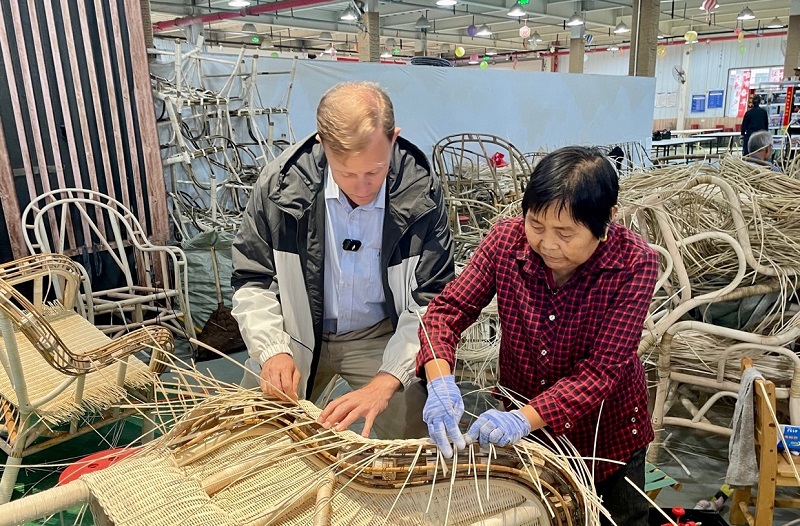
British TV host Inglis Iain learns to weave a rattan chair under the guidance of a Hanzhong craftsman on September 11, 2026.
The Present, Up Close
On September 8, the group was given an inside look at BYD R&D Center Showroom and the complex of solar tech giant LONGi in Xi’an, learning these leading brands’ history, signature products, and patented-technologies.
Alex Matthew Lamb, from the U.S., is an assistant AI professor at Tsinghua University. He showed great interest in the products and the applied technology, saying that in the age of digitization, the tech sector has significant potential to bring people together from different cultural backgrounds.

Syrian professor Rasha Khalil explores a BYD vehicle at Xi’an-based BYD R&D Center Showroom on September 8, 2026.
He used AI as an example to illustrate his point, explaining how AI is built on a complex technological stack, encompassing a vast number of technologies and services. Because each layer of this ecosystem requires different forms of expertise, countries can each contribute their own technological strengths and knowledge, creating opportunities for greater international cooperation and cross-cultural exchange, he explained.
A Bird Given Back to the Sky
If technology was the tour’s forward glance, ecology was its quiet surprise.
While humanity’s habitats are sprawling further into forests, biological conservation has come at the fore. In this regard, the conservation efforts in Yangxian Crested Ibis Ecological Park in Yangxian County, Hanzhong City have won much acclaim as all crested ibises around the world now are descendants of the seven birds – the only surviving crested ibis worldwide back then – which were discovered in 1981 in Yangxian.
On September 11, the group visited the nature reserve. A dozen crested ibises are currently living in a vast, high-netted enclosure, where they are constantly monitored to determine whether they are ready to be released into the wild. There are around 12,000 crested ibises worldwide, some 7,000 of them in Hanzhong.
Aoki Nobuo from Japan is the director of the International Research Center for Chinese Cultural Heritage Conservation at Tianjin University. He said that he was deeply moved by the fact that the crested ibis, once on the brink of extinction, is now able to soar through skies again. “It is the rigorous scientific approaches and the tireless efforts of the local community that have made this possible. This is powerful evidence that even ecosystems facing serious threats can recover and regenerate when supported by appropriate technological intervention and sustainable conservation systems,” he added.
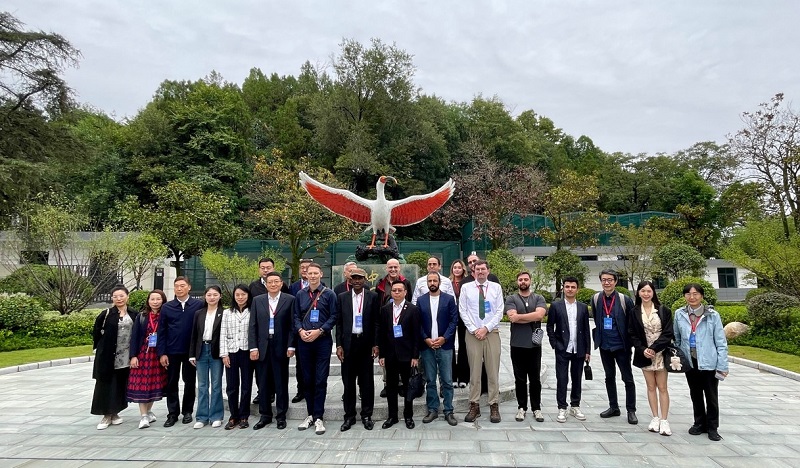
International and Chinese guests take a group photo at Yangxian Crested Ibis Ecological Park in Hangzhong City, Shaanxi Province on September 11, 2026.
Dutch social media influencer Sander Kole was struck by the cost of that success: for decades, farmers in Yangxian County have refrained from spraying chemicals on their fields to protect the wild crested ibis. It is, above all, a story of conservation shaped by ordinary people: the farmers of Hanzhong chose to give their land back to nature, just as Dutch farmers have, in another context, given land back to rivers. He also noted that environmental issues can bring people together around a shared goal and inspire them to work together for a better world.
Why the Journey Matters
By the end, the participants were describing the tour less as a trip than as an argument.
American historian Peter Ditmanson told China Today that the tour gave him a deeper understanding of China’s history while also offering insights into its present and future. From museums and historical sites to BYD’s electric vehicles and LONGi’s solar technology, he said that the tour showed how the past connects with modern development, emphasizing it also demonstrated that Chinese culture together with other cultures are not something fixed in museums, but a living tradition that continues to evolve through the interaction of science, technology, and society.
For the British TV host Inglis Iain, he saw the trip as an important opportunity for cross-cultural communication. He is firmly persuaded that beyond forums and formal dialogues, informal people-to-people exchanges like the tour can play an important role in building bonds among people from different countries.
Professor Brown echoed these words by saying that cultural exchange events serve as bridges that connect people and communities by fostering dialogue and mutual understanding across geographical and cultural boundaries. As a jury member of the 3rd Orchid Awards, he also added that the Orchid Awards embody this role by bringing people from different countries together, just as the Silk Road offers a historical example of how cultural connections can bring different civilizations closer together.
The international guests came to Shaanxi to look at a province. They left having done something the awards exist to encourage: they had met it.