From its historic role to modern status, Nanjing stands as a living testament to China’s enduring spirit of cultural exchange, peaceful development, and forward-looking engagement with the world.
In a remarkable convergence of global culture, three major events were staged in the historic city of Nanjing in east China’s Jiangsu Province, an ancient capital nourished by the Yangtze River, also a symbol of China’s enduring spirit. From November 21 to 23, the city hosted the “2025 Belt and Road Forum on International Think Tank Cooperation,” the “2025 Yangtze Culture Forum,” and an acclaimed international performance of China’s epic literary masterpiece The Dream of the Red Chamber. The gatherings drew hundreds of distinguished scholars and officials from across China, Asia, the Middle East, Africa, and Latin America.
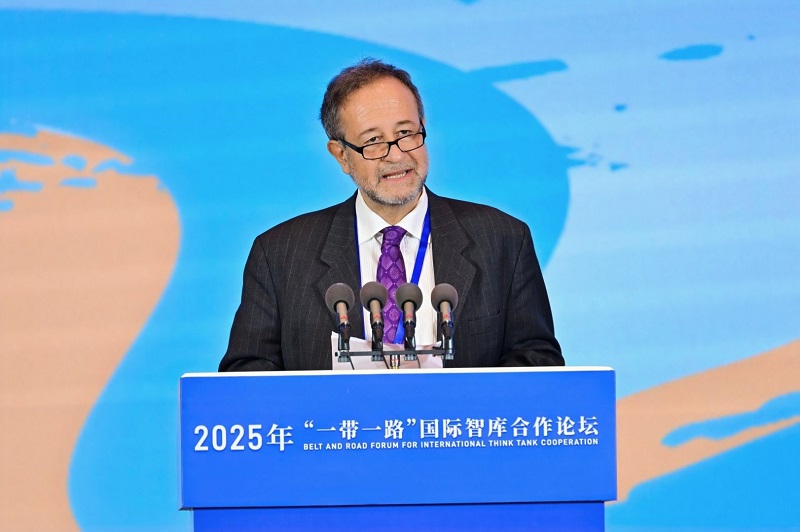
The author Augusto Soto speaks at the 2025 Belt and Road Forum on International Think Tank Cooperation.
For me, attending and speaking at these events was profoundly resonant. They unfolded mere weeks before 2026, a year that will mark the 40th anniversary of my first journey to China. I arrived in a nation then on the periphery of global affairs, just beginning its profound re-emergence. To return now, as a witness to this convergence in a dynamic and ancient city, Nanjing, it felt like connecting the tributaries of my own life with the powerful current of China’s present.
Nanjing’s Spirit: Ambition Without Dominion
During my address at the “2025 Belt and Road Forum on International Think Tank Cooperation” on November 22, I posed a reflective question: “What comes to mind when one thinks of Nanjing?” My own answer came readily: “a city of brave, enterprising, and remarkably clever people.” This sentiment was echoed by the international scholars I encountered, who regard Nanjing with a capital ‘H’ – for historic, and for heroic. This spirit is embodied in history by Admiral Zheng He, who launched his monumental voyages from near here in the early 15th century. His vessels dwarfed those of later European explorers, yet their mission stood in stark contrast: not conquest or colonization, but connection. They wove the first maritime Silk Road, a testament to an aspirational, rather than imperial, outlook. This legacy of peaceful engagement endures.
Furthermore, scholars at the November forums in Nanjing reaffirmed a consistent theme: across its vast and varied territory – from the western deserts and grasslands to the Pacific coastline – the People’s Republic of China has preserved its borders without invading its neighbors. This point carries profound and sobering resonance each year on December 13, when the nation observes the National Memorial Day for the Victims of the Nanjing Massacre. On that day in 1937, Japanese forces occupied the city and embarked on over six weeks of slaughter, killing more than 300,000 Chinese civilians and disarmed soldiers. The memory underscores, with historical gravity, the value of peace.
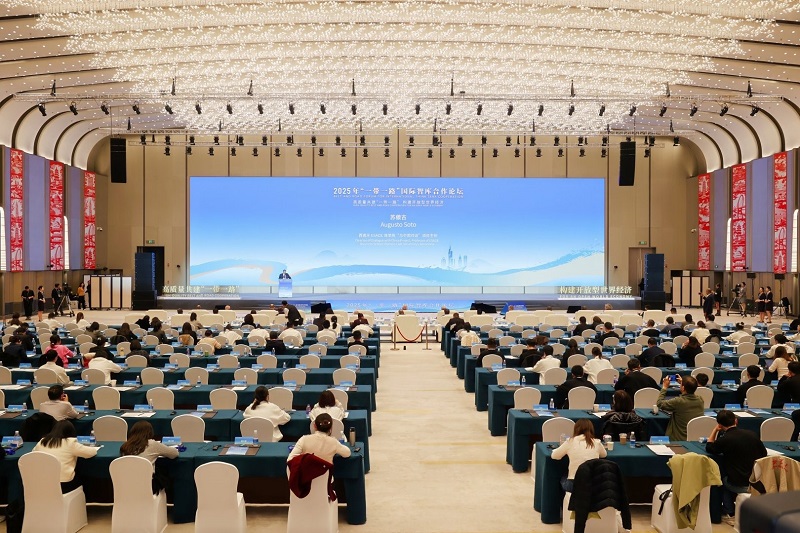
The 2025 Belt and Road Forum on International Think Tank Cooperation opens in Nanjing, east China’s Jiangsu Province, on November 21.
A Spanish Bridge to the Yangtze
It is a notable historical paradox that some of the nations which have most deeply studied China – producing many of the West’s finest sinologists – are also those that, centuries ago, sought to influence or even invade it. This is especially true of two Mediterranean powers: Spain and Italy. In March 1600, the Spanish scholar Diego de Pantoja arrived in Nanjing. Alongside his mentor, the Italian Jesuit Matteo Ricci, he immersed himself in Chinese culture. After a period of deep engagement with Nanjing’s local community, both men moved to Beijing. These two intellectual pioneers were cultural giants of their time, laying early groundwork for East-West dialogue. Their legacy reminds us that cities like Nanjing and Beijing have long served as vital bridges, not only between Spain and China, but between Europe and Asia as a whole.
In recent years, China-Spain relations have gained fresh momentum. Spanish Prime Minister Pedro Sánchez has visited China three times in the past three years, a diplomatic frequency unparalleled in EU-China relations over the last half-century. During one of his visits, in September 2024, in Kunshan, Jiangsu Province, he declared Spain’s commitment to “building bridges” with China, emphasizing negotiation and dialogue to advance mutual agreements. He also voiced strong support for multilateralism as a pathway to shared commercial prosperity. These principles align closely with the vision of the China-proposed Belt and Road Initiative (BRI). In November, King Felipe VI of Spain embarked on a significant official visit to China, beginning in Chengdu, situated near the Min River, a tributary of the mighty Yangtze, before traveling to Beijing for talks with Chinese leaders.
These high-level exchanges are reinforced by enduring people-to-people bonds. The sister-city partnerships between Jiangsu’s cities and Spanish localities – Lianyungang with Sabadell, Taizhou with Zaragoza, and Wuxi with Castelldefels – weave a quiet but constant tapestry of exchange. Together, they underscore Spain’s multifaceted connection to the Yangtze River region, a landscape emblematic of both Nanjing’s heritage and Jiangsu’s vitality. Thus, Jiangsu emerge not merely as historical sites, but as active theaters where history is being written today.
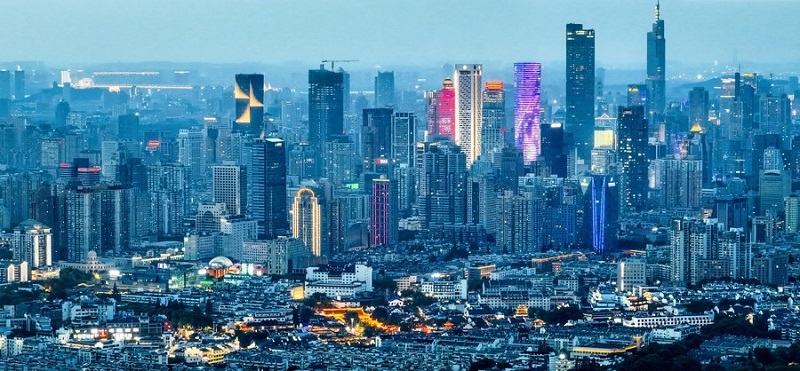
This aerial photo taken on June 11, 2023 shows the Fuzi (Confucius) Temple scenic area and the city view in Nanjing, east China's Jiangsu Province. (Xinhua/Yang Lei)
The Engine of the Delta: Culture, Education, and Vision
Jiangsu is not just a repository of history; it is an engine of the future. Strategically positioned near Shanghai, Jiangsu contributes over 10 percent of China’s GDP with only 6 percent of its population – a staggering feat rooted in more than economics. The region is an educational powerhouse. For a decade, the PISA rankings of the Organisation for Economic Co-operation and Development (OECD) have shown students from Beijing, Shanghai, Jiangsu, and Zhejiang – the core of the Yangtze River Delta – leading the world in reading, math, and science. It is fitting, then, that Nanjing is a UNESCO City of Literature, the birthplace of Cao Xueqin, who penned The Dream of the Red Chamber.
In Nanjing, the Yangtze’s waters carry more than silt; they carry the echoes of Zheng He’s sails, the scholarly dedication of Pantoja, the resilience of memory, and the vibrant energy of a region shaping tomorrow. To stand by its banks is to feel the deep, enduring pulse of a country that is continuously, and thoughtfully, engaging with the world.
_____________
AUGUSTO SOTO is director of the Spain-based Dialogue with China Project and former global expert in the United Nations Alliance of Civilizations.