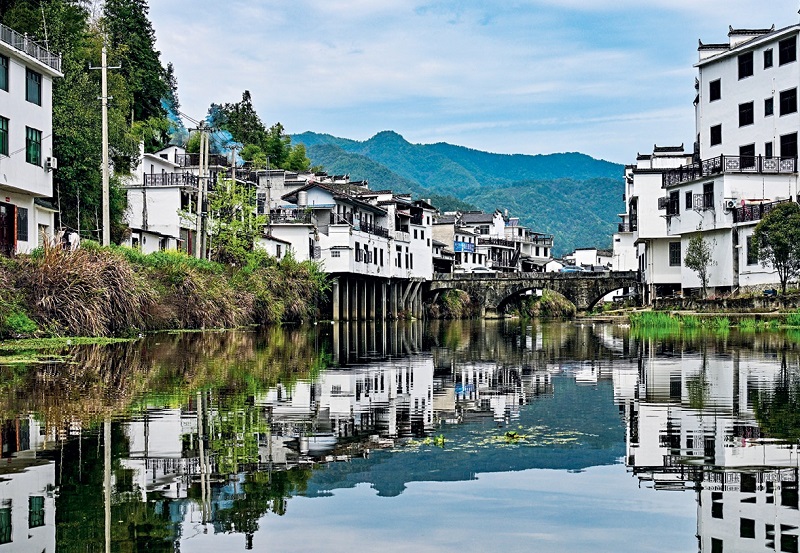
The water town in Zheyuan Township of Wuyuan, Jiangxi Province, exudes a classic ancient charm, with white-walled, black-tiled houses reflected in the clear stream and golden rapeseed flowers dotting the landscape, on April 2, 2026.
The Tang Dynasty (618-907) poet Wang Zhihuan, once wrote of climbing higher to see farther. Standing on a ridge above Wuyuan County in Jiangxi Province, looking at the fields of yellow rapeseed flowers spread out across the valley like liquid gold, I finally understood what he meant. But the view here reveals something more than natural beauty. It shows what happens when a nation decides that progress doesn’t have to mean leaving anyone behind.
China’s rural revitalization policy represents something rare in modern development. While many countries watch their rural areas become abandoned as young people head for greener pastures in the cities, China has realized that social harmony depends on preventing inequalities between urban and rural life. In Wuyuan, that policy is not abstract. It is in the noodles you eat, the roads you drive on, and the fireworks that light up mountain villages at dusk.
The infrastructure tells part of the story. High-speed trains now penetrate the heart of the region, while expressways cut through mountains that previously isolated these villages for centuries – modern transport connections that blend in seamlessly with the landscape.
But roads alone do not revive communities. I have seen what tourism dependency looks like when it goes wrong. My own home village of Burley in southern England, reinvented itself as a tourism hotspot in the 1990s. Today, it is so dependent on souvenir shops and tearooms that my mother, who grew up there, refuses to visit. “The village I grew up in is dead,” she says sadly.
Wuyuan seems determined to write a different ending, and the key is something harder to build than highways: a genuine community.
I found the proof of this at a homestay called Nature Cure Village Lodge, in Wantan Village. The young owners are not running a hotel; they are cultivating a hub. Stay here, and you immediately become part of the village’s social fabric – not as an observer, but as a participant. This can be as simple as having dinner with a local family in their “kitchen restaurant” and eating local produce while discussing village life. It’s the type of economics and personal connection that does not show up in GDP reports.
The next morning, I asked about the famous photo spots – those picturesque villages, pictures of which flood Chinese social media every spring. The owner pointed to a hand-drawn map on the wall. Yes, he could arrange a visit to the iconic sites. But his finger drifted to blank spaces between the marked attractions. “The crowds own those places now,” he said. “Let me show you places off the beaten track, where the crowds don’t go,” he said.
Within minutes we were in the back of a car driven by a trusted local driver, navigating our way on winding mountain roads. At our destination we walked through villages where no one rushed to sell us anything, where tea houses were simply someone’s front room with the door open, and where every cent I spent went directly into the pockets of the community.
The owners also organized what they called a “culture day,” though it felt more like visiting friends rather than business partner. High up in the mountains we met Master Yu, a local artisan and craftsman. His gallery is filled with exquisite local wood carvings, each piece full of Wuyuan vitality. He walked us through the small village, introducing us to fellow artisans he is helping to form a cooperative – a living network to keep traditional crafts alive. He also hosts workshops at his gallery, passing his precious skills to new generations.
Nearby, Master Hu and his wife run a bamboo parasol workshop that fills the air with the smell of resin and oil. The walls display hand-painted canopies in colors so vivid they seem to flutter. Even though the workshop is quiet during the Wuyuan fireworks festival season, we sensed that this place plays a special role in the revitalization ecosystem. By buying a handmade parasol you become an investor in rural revival.
The day ended in Qingshi Village, high in the mountains. By the time we arrived, night had already fallen, and the village hummed with anticipation – narrow streets packed with families, children perched on shoulders, and elders on stools.
Then the sky exploded. For two hours, a relentless barrage of fireworks filled the night sky. Below the flashes of light a “bench dragon” undulated its way through the streets, seeming to move to the beat of the explosions above. Each family in the village carried a bench that were all linked together to create a community dragon. To add more color to the festivities, each bench incorporated five lanterns, transforming the bench dragon into a river of fire. A local explained the festival’s meaning in the local dialect. “It’s all for the ancestors. The fireworks, the dragon, the dancing, everything is to tell the ancestors that the village is thriving, and that we share our success with them.”
That night, as Qingshi’s past and future combined in a blaze of glory, one thing became clear: in this corner of Wuyuan, rural revitalization is not merely succeeding – it’s blossoming. Standing there, I realized this was the answer to my mother’s lament. Burley died because it became a place to visit. Qingshi lives because it remains a place to belong.
Travel here being aware of your surroundings and you do not just witness rural revitalization, you buy into it. Literally, that parasol, those noodles, and chatting about village life. Small investments, perhaps, but in a community that measures wealth in continuity, they compound.
The Chinese poet Wang Zhihuan climbed his tower to see farther. In Wuyuan, the view from the heights shows something worth climbing for: proof that modernization and tradition aren’t opposites, that progress need not mean leaving the past behind, and that the most sustainable development may simply be the kind that keeps people busy at home. 
CHRIS NASH is former chairman of the Society for Anglo-Chinese Understanding, and current international education manager of Beijing Dacheng Education Group.