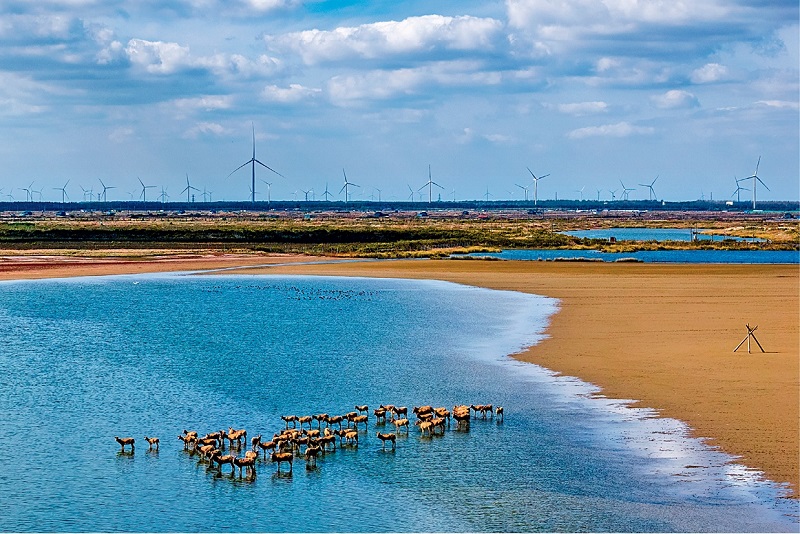
Milu deer forages for food in the Tiaozini Wetland in Dongtai of Yancheng City, east China’s Jiangsu Province.
When addressing the Leaders Summit on Climate in April 2021, Chinese President Xi Jinping called for the world to foster a community of life for humanity and nature, offering the Chinese solution to challenges in global environmental governance. Over the past years, this vision has translated into broad consensus, providing guidance and adding momentum to global efforts to protect biodiversity.
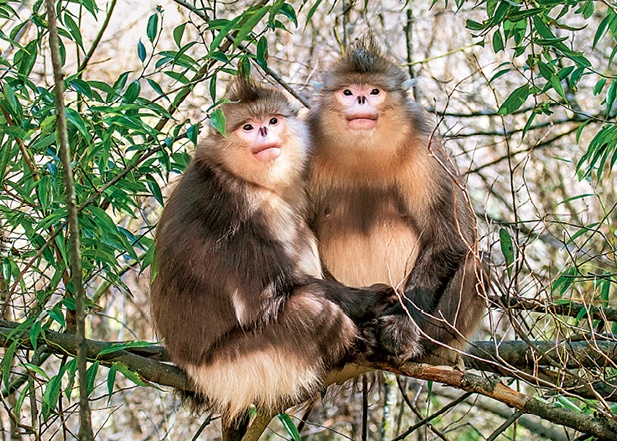
Yunnan snub-nosed monkey is a protected animal, living in a national park in Tacheng Town of Weixi Lisu Autonomous County, southwest China’s Yunnan Province.
Progress in the New Era
Xi Jinping Thought on Ecological Conservation sets the direction for ecological conservation in the new era. The president’s observations, such as “humanity and nature form a community of life” and “society will prosper when the environment improves,” highlight the interdependence between humanity and nature, stressing that biodiversity is essential for human survival and development.
President Xi pointed out that the environment is a unified system consisting of organic chains that are intricately interdependent and firmly interconnected. He hence urged people to move beyond the fragmented governance model and instead address environmental issues from a holistic and systemic perspective. Inspired by the principle, “lucid waters and lush mountains are invaluable assets” that he put forward, China is advancing biodiversity conservation and economic development in parallel.
As President Xi pointed out, if China handles its own affairs well, that in itself is a contribution to the world. Over the past years, China has made steady progress in biodiversity protection by adapting to new situations and seeking innovations.
Biodiversity conservation has become a national strategy. China has established a coordination mechanism under the State Council to strengthen biodiversity conservation, and issued the Guidelines on Further Strengthening Biodiversity Conservation. It has also adopted the national biodiversity conservation strategy and action plan (2023-2030), an update of its 2011-2030 plan. This makes China the seventh country and the first developing country in the world to update its strategic action plan since the adoption of the Kunming-Montreal Global Biodiversity Framework (hereinafter referred to as the Kunming-Montreal Framework) in 2022.
The in-situ conservation system has been continuously improved, reinforcing ecological security barriers. China has developed a national park-based system of protected areas, identified 49 national park candidate areas, officially designated five national parks, and set up more than 2,600 nature reserves. Through these measures, it effectively brings 90 percent of its terrestrial ecosystem types and 74 percent of key wildlife populations under state protection. At the same time, China has introduced innovative models for ecological space protection and set ecological conservation red lines to safeguard ecological security. As a result, both forest coverage and forest stock volume have increased for 40 consecutive years, making China the unrivalled greening champion in the world.
Ex-situ conservation has also been strengthened, yielding notable results in systematic restoration. So far, China has established a relatively complete ex-situ conservation system that includes botanical gardens, wildlife rescue and breeding centers, germplasm banks, and gene banks. It has carried out a number of major projects for ecosystem protection and restoration that have delivered remarkable outcomes. For example, China has launched 52 projects under the Shan-Shui Initiative (which translates as mountains and rivers initiative), rehabilitating approximately eight million hectares of land. This initiative earned a place among the UN’s 10 inaugural World Restoration Flagships. Rare and endangered wildlife populations are growing, demonstrating notable achievements in biodiversity conservation. In Hoh Xil, the number of wild Tibetan antelopes has grown from fewer than 20,000 to over 300,000, leading to the species being downgraded from “endangered” to “near threatened.” Similarly, the wild population of giant pandas has increased by 67 percent over the past 40 years. Moreover, the Yangtze sturgeon, which was declared extinct in the wild in 2022 by the International Union for Conservation of Nature, is now reproducing naturally. These are only some of the examples of China’s successful conservation of rare and endangered species.
The benefit-sharing system has been continuously improved, bringing green dividends to millions of families. Through sustainable use and benefit sharing, a country can transform ecological resources into sustained economic and social benefits. China’s Guidelines on Further Strengthening Biodiversity Conservation, issued in 2021, sets the goal of establishing a robust system for accessing biological genetic resources and sharing the benefits. The Ministry of Ecology and Environment has identified sustainable use and benefit sharing as one of the four priority areas in its biodiversity conservation strategy and action plan. It encourages the creation of pilot zones for access to biological genetic resources and benefit sharing in regions such as Yunnan, Hunan, and Guangxi to explore pathways for rural revitalization and green development.

Shennongjia in Hubei Province is one of China’s three centers of biodiversity.
 Bigger Role on the World Stage
As President Xi pointed out, both biodiversity protection and global environmental governance require persistent efforts by all parties concerned. As the world’s largest developing country, China is willing to shoulder its responsibility as a major country, pursue green development, and work with other countries to reinforce the foundation of global ecological progress.
Over the past decades, China has transformed from a participant to a leader in global environmental governance. The 15th meeting of the Conference of the Parties to the Convention on Biological Diversity (COP15), held in the Chinese city Kunming in 2021, adopted the theme “Ecological Civilization: Building a Shared Future for All Life on Earth,” marking the first global conference themed on ecological civilization hosted by the United Nations. As the presidency of COP15, China played a leading role in the adoption of a landmark package of outcomes, including the Kunming-Montreal Global Biodiversity Framework. Inger Andersen, executive director of the United Nations Environment Programme (UNEP), commented that China’s ability to integrate economic growth with biodiversity conservation offers valuable lessons for the world.
China also supports the biodiversity conservation efforts in other developing countries. In May 2024, the Kunming Biodiversity Fund, initiated by China with an investment of RMB 1.5 billion (US $207 million), was officially launched. Focusing on the 23 goals of the Kunming-Montreal Framework, the Fund directs financial resources to key areas such as ecosystem protection and restoration, sustainable use of biodiversity, and the sharing of benefits from genetic resources and digital sequence information on genetic resources. Its first batch of nine projects covers 15 developing countries across six continents, while the second batch of 22 projects involves 34 developing countries. Moving beyond the traditional donor-recipient model, the Fund operates as an equal cooperation platform based on the principle of common but differentiated responsibilities. Elizabeth Maruma Mrema, deputy executive director of the UNEP, commended it for playing an important role in bridging the funding gap in biodiversity protection.
China has deepened practical cooperation and contributed its solutions to global issues. Its principle that “lucid waters and lush mountains are invaluable assets” offers other Global South countries a development path distinct from the Western modernization model. Through South-South cooperation, China has provided support for biodiversity conservation in more than 80 developing countries. In November 2019, China and France jointly released the Beijing Call for Biodiversity Conservation and Climate Change. China has also carried out cross-border conservation projects with Russia, Mongolia, Laos, Vietnam, and other countries to protect rare and endangered species such as the Siberian tiger, Amur leopard, and Asian elephant, along with their relevant habitats. These efforts demonstrate China’s strong sense of responsibility as a major country and its global vision.

Reporters and reserve workers check an infrared camera in the woods of Qingchuan County, Guangyuan City, southwest China’s Sichuan Province.
Contribution to Global Governance
At present, the international balance of power is undergoing profound changes, yet the reform of the global governance system is struggling to catch up. China firmly opposes unilateralism and protectionism, upholds international rule of law, and abides by conventions such as the Convention on Biological Diversity, which serve as institutional constraints on ecological destruction.
This year, a comprehensive assessment will be made of the progress in achieving the targets of the Kunming-Montreal Framework, indicating a critical stage in global biodiversity governance. Committed to equity and justice, China fully respects the actual needs of developing countries and advocates for the right of all nations to equal participation and development, so that the benefits of biodiversity conservation reach people in more equitable and fairer ways. China also focuses on taking real actions, earnestly translating consensus into policy measures, projects, and assessment indicators to ensure the fruition of the Kunming-Montreal Framework.
Biodiversity protection is a common concern for all humanity, yet there is no one-size-fits-all approach to achieving it. As ancient Chinese philosophers put it, “All living things should flourish without harming each other, and all ways of being should thrive without conflicting with one another.” We should respect and support the diversity of ecological cultures, draw inspiration from the outstanding ecological cultures of all nations, and harness all forces driving biodiversity conservation. In doing so, countries can develop distinctive conservation models suited to their local conditions. At the same time, countries must respect the national conditions of each other, reject cultural hegemony in the field of ecological conservation, and seek common ground while reserving differences to achieve mutual benefit and win-win outcomes.
As an important participant, contributor, and leader in global biodiversity conservation, China has remained committed to multilateralism as well as international exchanges and cooperation. Through mechanisms and platforms such as the BRI International Green Development Coalition and South-South cooperation, China continues to deepen pragmatic bilateral and multilateral cooperation and experience sharing in areas such as wildlife protection, ecological conservation and restoration, and biosecurity management. China is also working for the effective utilization of the Kunming Biodiversity Fund, so that the capital, technical support, and capacity-building assistance that it provides will be able to benefit more developing countries.
Guided by the vision of building an ecological civilization, China is working with countries around the world to foster a fair, equitable, and win-win global environmental governance system through cultural exchanges, mutual learning, and multilateral cooperation. This joint effort will lead the world toward a harmonious coexistence of humanity and nature, and onto a path of high-quality development.
HU JUN is the director of Policy Research Center for Environment and Ecology and Research Center for Xi Jinping Thought on Ecological Conservation, Ministry of Ecology and Environment.