When business leaders, policymakers, scholars, and entrepreneurs gather for the Summer Davos forum in Dalian, China, on June 23-25, they did so at a time when the global economy is searching for a new equilibrium after the stalled war in the Persian Gulf. Wars in Ukraine and the Middle East as well as geopolitical rivalry alongside inflation, energy transitions, demographic pressures, and the rapid rise of Artificial Intelligence and military drones may unsettle the current world in a dangerous tailspin. While technological innovation remains the most powerful engine of our economic growth and global human progress no conversation about innovation can be complete without analyzing China’s role.
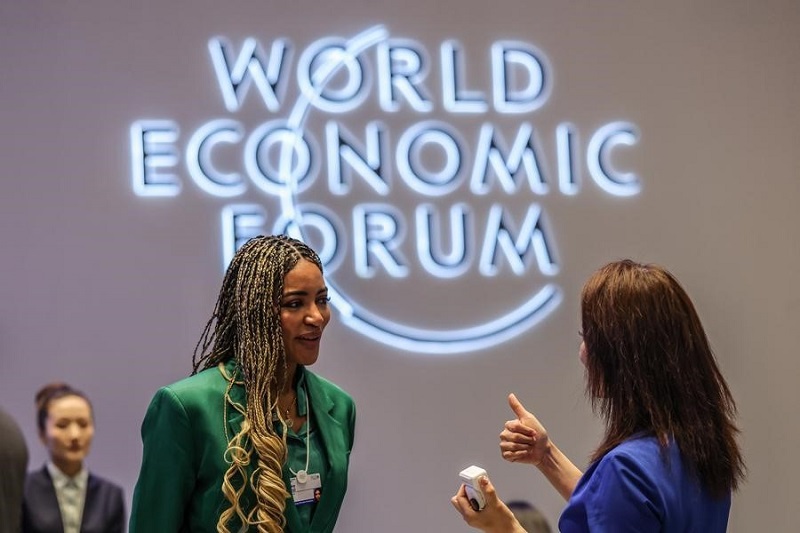
Participants talk before the opening plenary of the 17th Annual Meeting of the New Champions, also known as the Summer Davos, at the Dalian International Conference Center in Dalian, northeast China's Liaoning Province, June 24, 2026. (Xinhua/Pan Yulong)
For much of last century, economic modernization followed a Western path. Innovation flowed from research laboratories in North America and Western Europe, while manufacturing spread outward through global supply chains. In the last 50 years, however, China has evolved into one of the world’s leading centers of technological development. In fields ranging from advanced manufacturing and renewable energy to AI, electric vehicles, telecommunications, digital payments, and logistics, Chinese companies and research institutions have become important global players, shifting to a model of technological creation.
Historically, periods of growth have emerged when new technologies lowered costs, expanded productivity, and connected markets. The steam engine, electricity, the microchip, and the internet each spawned transnational economic ecosystems – powering Britain’s Industrial Revolution, America’s postwar boom, and China’s trajectory since the launch of its reform and opening-up. Today, technologies, from AI to green energy stand ready to drive a similar metamorphosis – provided they are not shackled by political rivalries.
Indeed, we face the contradictory challenge of sustaining economic growth while reducing carbon emissions, an obstacle often igniting social tension in the USA and the European Union. Affordable solar panels, battery technologies, electric mobility, and advanced energy infrastructure are essential to achieving this crucial goal and Chinese firms have contributed to scaling these technologies while reducing their costs, making them accessible to both developing and developed economies. The same framework may be applied to digital infrastructure. Economic activity is now fueled by smartphones, digital platforms, mobile payments, and online commerce. Chinese cities have become laboratories for technological experimentation in these decisive fields.
Summer Davos, alas, cannot skip the geopolitical tensions between major powers: export controls, industrial policies, supply-chain diversification, tariffs and concerns about national security increasingly slow markets governed primarily by commercial logic until a few years ago. When American politician and diplomat George Shultz first joined President Richard Nixon’s administration, Bryce Harlow, former adviser to President Dwight Eisenhower, offered him a piece of advice “Trust is the coin of the realm.” On his 100th birthday, Shultz, President Ronald Reagan’s Secretary of State, remarked “When trust was in the room, whatever room that was – the family room, the schoolroom, the coach’s room, the office room, the government room, or the military room – good things happened. When trust was not in the room, good things did not happen. Everything else is details.”
History shows that technological revolutions flourish when trust, ideas, talent, capital, and research circulate across borders, as evidenced by the Republic of Venice during the 14th and 15th centuries. This interdependence still defines modern innovation: the microprocessor contains the intellectual contributions of many nations, and Large Language Models are built upon research generated by global communities of scientists and engineers. Competition drives innovation and stifles isolation. Therefore, international observers will continue to debate issues involving regulation, intellectual property, market access, data governance, and transparency and indeed economic relationships will depend on candid dialogue around areas of disagreement.
At the same time, reducing China to a geopolitical rival alone would be an historical mistake because a breakthrough in battery storage in Shenzhen may benefit factories in Italy, advances in artificial intelligence in Hangzhou may influence researchers in Princeton or Milan. New supply-chain solutions developed in China may reduce costs for consumers across Africa, Europe, and Latin America.
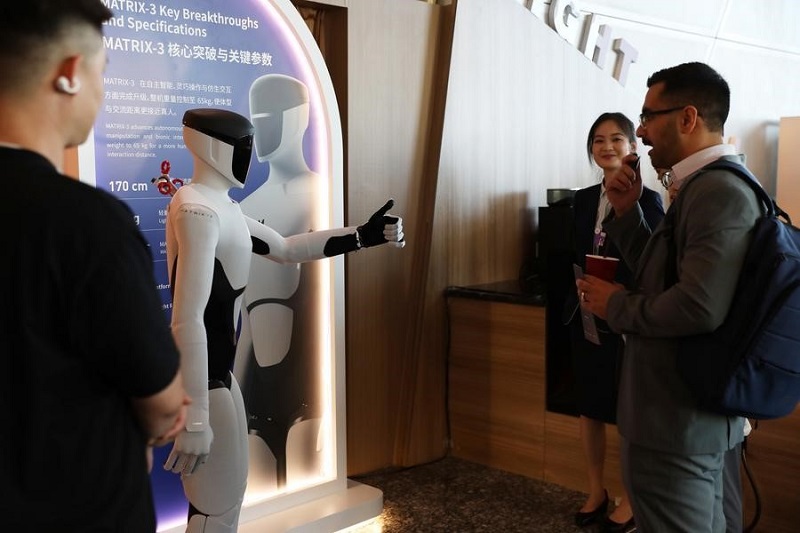
A robot gives a thumb up to a participant of the 17th Annual Meeting of the New Champions in Dalian, northeast China's Liaoning Province, on June 23, 2026. (Xinhua/Liu Lingyi)
In this evolving landscape Europe should remain committed to openness, international cooperation, scientific inquiry, and democratic governance engaging with both the United States and China while defending its values and strategic interests. The future will not be determined solely by who develops the most advanced technology. It will mostly depend on who can build real trust around technology.
AI promises brisk advances in medicine, education, scientific discovery, and productivity. Yet it also raises concerns on employment, privacy, misinformation, and security. This is where Summer Davos should focus: while China’s technological development is one of the defining stories of our time, the task ahead is now to guide innovation and AI wisely. At the 1956 Dartmouth Summer Research Project on Artificial Intelligence, where the term "artificial intelligence" was coined, the official proposal drafted by John McCarthy, Marvin Minsky, Nathaniel Rochester, and Claude Shannon boldly stated: "We propose that a 2-month, 10-man study of artificial intelligence be carried out during the summer of 1956... The study is to proceed on the basis of the conjecture that every aspect of learning or any other feature of intelligence can in principle be so precisely described that a machine can be made to simulate it." We should re-enact this spirit and elan.
If the twenty-first century is to be remembered as an era of prosperity rather than fragmentation, technological leadership must be accompanied by openness, responsibility, and cooperation. Premier Li Qiang’s address at the Summer Davos forum captures this zeitgeist, championing connectivity and collaboration to forge greater synergy for global innovation. The world does not suffer from an oversupply of innovators; it suffers from an undersupply of connections between them. This is precisely the charge of the Annual Meeting of the New Champions (Summer Davos): in a period marked by uncertainty, innovation remains a source of hope – and hope grows stronger when shared.
(The article reflects the author’s opinions, not necessarily the views of China Today)
__________
GIANNI RIOTTA is director of Luiss University School of Journalism, Rome, Italy, and visiting professor of Princeton University.