Mid-May witnessed a profound diplomatic spectacle in Beijing. Just days after the state visit of U.S. President Donald Trump, Russian President Vladimir Putin touched down in China for his state visit. This flurry of high-level diplomatic engagements, which included recent visits by leaders of Germany and the United Kingdom, among certain other countries, constitutes an unprecedented “diplomatic relay.”
This historic convergence is no coincidence; it is a collective endorsement of a shifting global order. As geopolitical conflicts escalate, economic recoveries falter, and unilateralism resurges, the world has critical need of an anchor in an era defined by uncertainty. Unshakeable in its stability, unwavering in its commitment to peaceful development, and vibrant in its advocacy for mutual learning among civilizations, China has decisively positioned itself as an indispensable “anchor of stability, inclusive development, and harmonious co-existence” for the world.
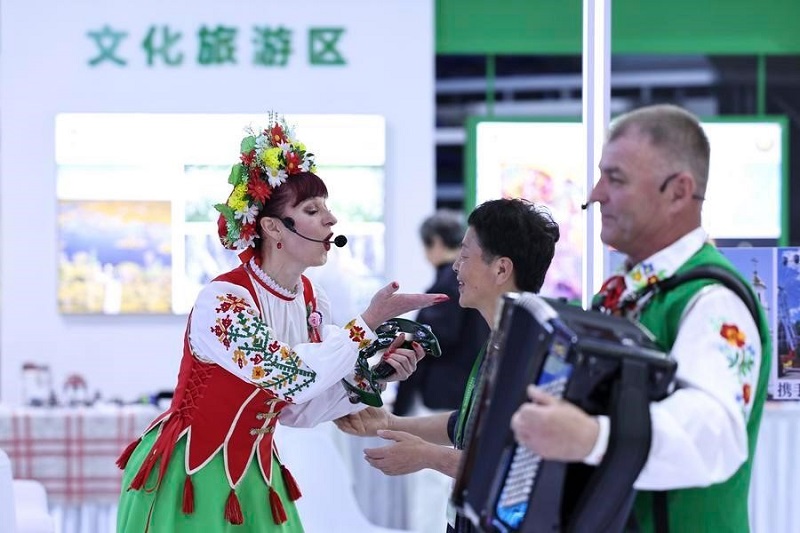
A performer interacts with an attendee at the 10th China-Russia Expo in Harbin, northeast China's Heilongjiang Province, May 17, 2026. (Xinhua/Zhang Tao)
At the core of China’s magnetic pull is its unparalleled stability – in stark contrast to the political fluctuations apparent in many Western democracies. Since the inception in 1953 of its First Five-Year Plan, China has launched 15 five-year plans. This governance model, characterized by long-term strategic vision and remarkable policy continuity, has been universally recognized as one of the contemporary world’s most effective modes of national governance. For international partners, China is no longer just a market; it is a predictable, reliable, and stable pillar of the global system.
Nowhere is this stability more crucial than in China’s management of its relationships with other major countries. During U.S. President Trump’s visit, the two heads of state agreed upon a new vision: building a constructive China-U.S. relationship of strategic stability. As elucidated by China’s top diplomat Wang Yi, this “constructive strategic stability” should embody a positive stability where cooperation is the mainstay, a sound stability geared to managing moderate competition, a constant stability where differences are manageable, and an enduring stability that rejects the notion of conflict or war.
In a similar vein, President Putin emphasized that the Russia-China relationship functions as an essential stabilizing factor amid a turbulent international landscape. In consciously choosing dialogue over confrontation and multilateralism over unilateralism, leaders of the world’s major countries manifest a definitive “vote of confidence” in China’s diplomatic philosophy. China is proving that it possesses the wisdom and gravitational pull necessary to steer major-country relations clear of the rocks of escalation toward the calmer waters of peaceful coexistence.
China’s stability organically propagates the economic prosperity and openness that has transformed the nation into the world’s powerful engine of inclusive development. In an era where, unfortunately enough, protectionism and “decoupling” threats are on the rise, China remains steadfastly committed to high-level opening-up and multilateralism. In so doing, China safeguards the integrity of global industrial and supply chains, thus providing the precious measure of certainty that the world so desperately needs.
The sheer scale of China’s market, combined with its comprehensive modern industrial system, has transformed cooperation with China from an optional perk into a strategic “must-have” for many countries and corporations alike. The recent 2026 China-California Business Forum, which brought together 550 government officials and business leaders, perfectly encapsulates this reality. As Chinese Ambassador to the U.S. Xie Feng noted, sub-national cooperation between China and California functions as an iconic model of mutual respect and win-win cooperation.
This sentiment is echoed by Wall Street and Silicon Valley executives. Despite global headwinds, U.S. business giants are doubling down on their investments in China. Pharmaceutical leader Eli Lilly has announced a massive US $3 billion investment to expand its manufacturing and supply system in China over the next decade. Health and wellness giant Amway recently launched in Chengdu its first self-owned organic farm outside the Americas, so recognizing China not merely as a consumer market, but also as a strategic engine of global innovation. And a staggering 72 percent of U.S. companies anticipate industry growth in 2026, around 57 percent of whom plan to increase their investments in China, according to a survey by the American Chamber of Commerce in China.
True stability and economic integration, however, cannot thrive without mutual understanding among different cultures. Rooted in the ancient Chinese philosophy of “harmony without uniformity,” China proactively champions the Global Civilization Initiative, thereby fostering an atmosphere wherein diverse cultures may coexist, communicate, and flourish together.
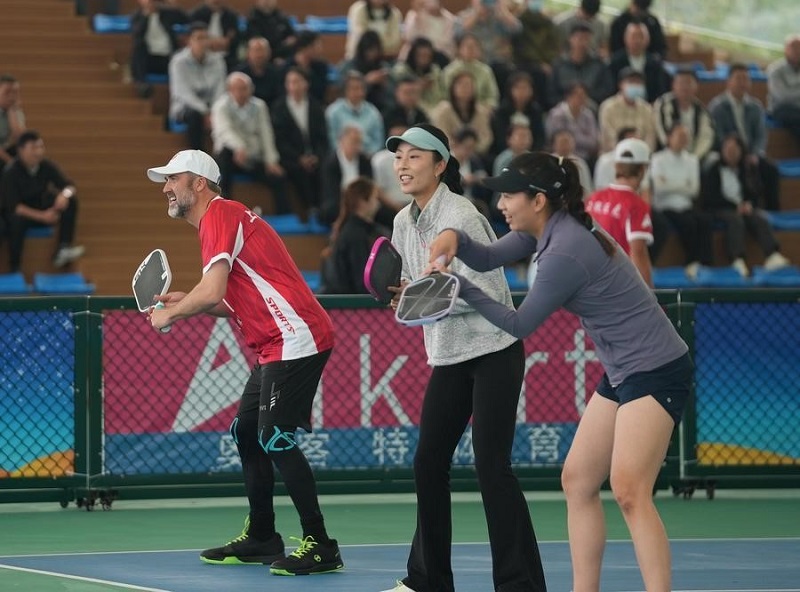
Wesley Gabrielson (L), captain of the Oregon Friendship Pickleball men's team, plays pickleball with Chinese player Liu Mingyang (C) and Tang Yutong during the 2026 China-U.S. Friendship Pickleball Event held in Shangyou County of Ganzhou City, east China's Jiangxi Province, May 9, 2026. (Xinhua/Hu Chenhuan)
A gratifying testament to this vision played out on the pickleball courts of Ganzhou, Jiangxi Province, in early May 2026. During the China-U.S. Friendship Pickleball Event, young American and Chinese players bonded effortlessly, despite language barriers, communicating fluently through paddles and smiles by virtue of their shared love for the sport. For American student Ella Boydston, viewing the breathtaking backdrop of Ganzhou’s green mountains while playing pickleball was an unforgettable memory. But for veteran delegate Judy Hoarfrost, a participant in the historic 1971 Ping-Pong Diplomacy, the sight of these bright-eyed youths renewing the bonds of friendship 55 years later was a deeply moving full-circle moment. Whether through pickleball, table tennis, basketball, or baseball, sports act as a universal language that dissolves prejudices and builds lasting interpersonal trust.
The ever more frequent visits of global leaders to Beijing constitute a resounding vote of confidence in China’s development trajectory, and its pivotal role in shaping the future world order. The gravitational pull of China’s stable development, paired with its inclusive and forward-looking global vision, presents a counterweight to rising geopolitical fragmentation and fosters collective progress.