The 62nd Munich Security Conference (MSC 2026) concluded just days before the Lunar New Year ushered in the Chinese Year of the Horse on February17. Its resounding message was clear: in rebuilding a multilateral international system of shared responsibilities – a goal championed by the EU, China, and much of the world –there can be no shortcuts, distractions, or selective imperialism. The path forward lies in reinvigorating the institutions we have nurtured for 80 years. As Chinese Foreign Minister Wang Yi stated in front of an attentive audience of over 40 heads of state and government, along with global leaders and analysts, “This (United Nations) edifice was jointly built by the people of the world.”
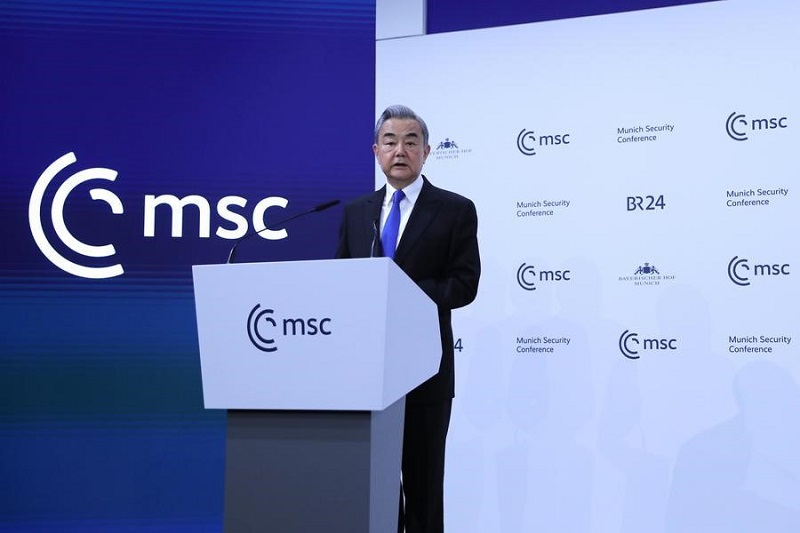
Chinese Foreign Minister Wang Yi, also a member of the Political Bureau of the Communist Party of China Central Committee, delivers a speech at the "China in the World" session of the Munich Security Conference in Munich, Germany, Feb. 14, 2026. (Xinhua/Du Zheyu)
This call for steadiness contrasted sharply with the turbulence created by Washington. Against a backdrop of persistent global instability, a U.S. Supreme Court decision on February 20 overturned existing tariffs, prompting Trump to swiftly impose a 10 percent global tariff, raised hours later to 15 percent. This move throws all international trade deals into question. Following a familiar pattern, such dramatic domestic reversals often presage further international threats. One must wonder: what will come next?
The tone for the MSC 2026, was set by a 123-page Munich Security Report. It grimly declared that we have entered an ominous period where “the US-led post-1945 international order is now under destruction.” Wang Yi responded not with dismay, but with resolve: “We have every responsibility to reinforce and renovate it, and no right to destroy or tear it down.” He attributed the system’s malfunction not to the UN itself, but to “certain country seeking to magnify differences and disagreements, put itself above everyone else, stoke bloc confrontation and even revive the Cold War mentality.”
At the 62nd MSC, U.S. Secretary of State Marco Rubio gave a cajoling speech which was cautiously welcomed by a significant number of policymakers, military leaders and analysts who grew up during the Cold War. At first glance his speech was in contrast to the confrontational and threatening tone of U.S. Vice President J.D. Vance’s speech a year ago, which came as a shock.
Rubio acknowledged the U.S. as the civilizational “child of Europe,” praising contributions from Mozart to Michelangelo and Da Vinci, and even noting the Spanish origins of the American cowboy archetype. Yet, this emotional appeal conspicuously omitted any mention of the crucial military and financial support from France, Spain, and the Netherlands in the U.S. attainment of independence 250 years ago.
Let us not be confused. As at the World Economic Forum Annual Meeting 2026 in Davos a few weeks ago, much of the applause for Washington’s representatives stemmed from courtesy, habit, or fleeting relief. The world has grown weary of the United States’ constantly disruptive promises.
Rubio’s subtext was unmistakable: he envisions a Europe in a state of vassalage, which is utterly unacceptable in Brussels and across the continent.
EU foreign policy chief Kaja Kallas offered a direct rebuttal: “Contrary to what some may say, woke, decadent Europe is not facing civilizational erasure. In fact, people still want to join our club, and not just fellow Europeans…. over 40 percent of Canadians have an interest in joining the EU.”
In times of crisis, facts outweigh emotions or exhaustive historical references. This is precisely where the views and proposals put forward by China in Munich – free from cajoling or paternalism – come into play. There is a growing consensus, both implicit and explicit, that these ideas, rooted in common sense, resonate with most of the EU and with nations across Latin America, Africa and Asia.
Wang Yi reminded the audience that over 60 conflicts still dragging on worldwide inflict traumatic suffering to the affected populations. This moral stance is backed by action: with around 1,800 personnel in UN peacekeeping missions and as the second-largest financial contributor, China is the top provider of peacekeepers among the UN Security Council’s permanent members.
The international community is increasingly familiar with the Global Governance Initiative (GGI) President Xi Jinping proposed last September. It stresses that while imperfect, the UN remains the most universal and authoritative intergovernmental organization, where every nation, “regardless of its size or wealth, has a voice and a sacred vote.” Wang Yi elaborated, “Time will prove that the more democratic international relations are, the more peaceful the world is; the stronger multilateralism gets, the more effective global governance becomes.”
The contrast sharpens as China begins implementing its 15th Five-Year Plan for economic and social development. “We aspire for a stable external environment for our development, and we also hope to make the world a better place through our development,” Wang Yi stated. Herein lies a potent, implicit synergy to be fully realized in the EU-China relationship.
History’s shadows loom large. Europe failed itself and humanity in 1938 when the Munich Agreement failed to prevent a war that would claim tens of millions of lives worldwide. The stakes today are similarly monumental.
It is worth recalling that, as Singaporean diplomat Kishore Mahbubani noted, China is the only permanent Security Council member that has not fired a single shot outside its borders in nearly half a century. It is also worth heeding the strategic warnings of French President Charles de Gaulle, who told German Chancellor Konrad Adenauer in 1958 that Washington “understood nothing about history or Europe,” and feared America could “become a threat to peace.” A January poll by the European Council on Foreign Relations seems to echo this, finding only 16 percent of EU citizens view the U.S. as an ally, while 20 percent see it as a rival or enemy.
Consistency is key. Secretary Rubio said in Munich, “We will always be a child of Europe.” Yet we Europeans are not content with this current situation. We were proud with the child that helped defeat Nazism, fought against genocide, reached for the Moon, and pioneered scientific frontiers. We were proud when it reached out to Beijing in the early 1970s and contributed to a better understanding of China in the West. Now it has seemingly forgotten that legacy.
The global situation demands collective action through the world’s foremost organization, the UN. It requires the vitality and strength symbolized by the Horse now guiding the Chinese lunar year.
As the adage often attributed to Abraham Lincoln reminds us, “You can fool all the people some of the time, and some of the people all the time, but you cannot fool all the people all the time.”
A word to the wise, no doubt.
____________
AUGUSTO SOTO is director of the Spain-based Dialogue with China Project and former global expert in the United Nations Alliance of Civilizations.