| Energy Saved Is Energy Earned
By staff reporter ZHOU CHANG
STARTING from the first day of 2010, China Mobile's subscribers began receiving special short messages to remind them to conserve energy – things like "A New Year begins with you. Take public transit as much as you can. Choose energy-efficient household appliances. Use water sparingly." Bus-borne televisions joined in by broadcasting public service advertisements for various energy-saving products. In the marketplaces, a fresh promotional campaign for energy-saving electrical products is also just getting underway.
"The term 'energy-saving' has become increasingly popular in recent years," said Wang Zhe, "no matter where you are, you can see or hear things related to conserving energy."
 |
|
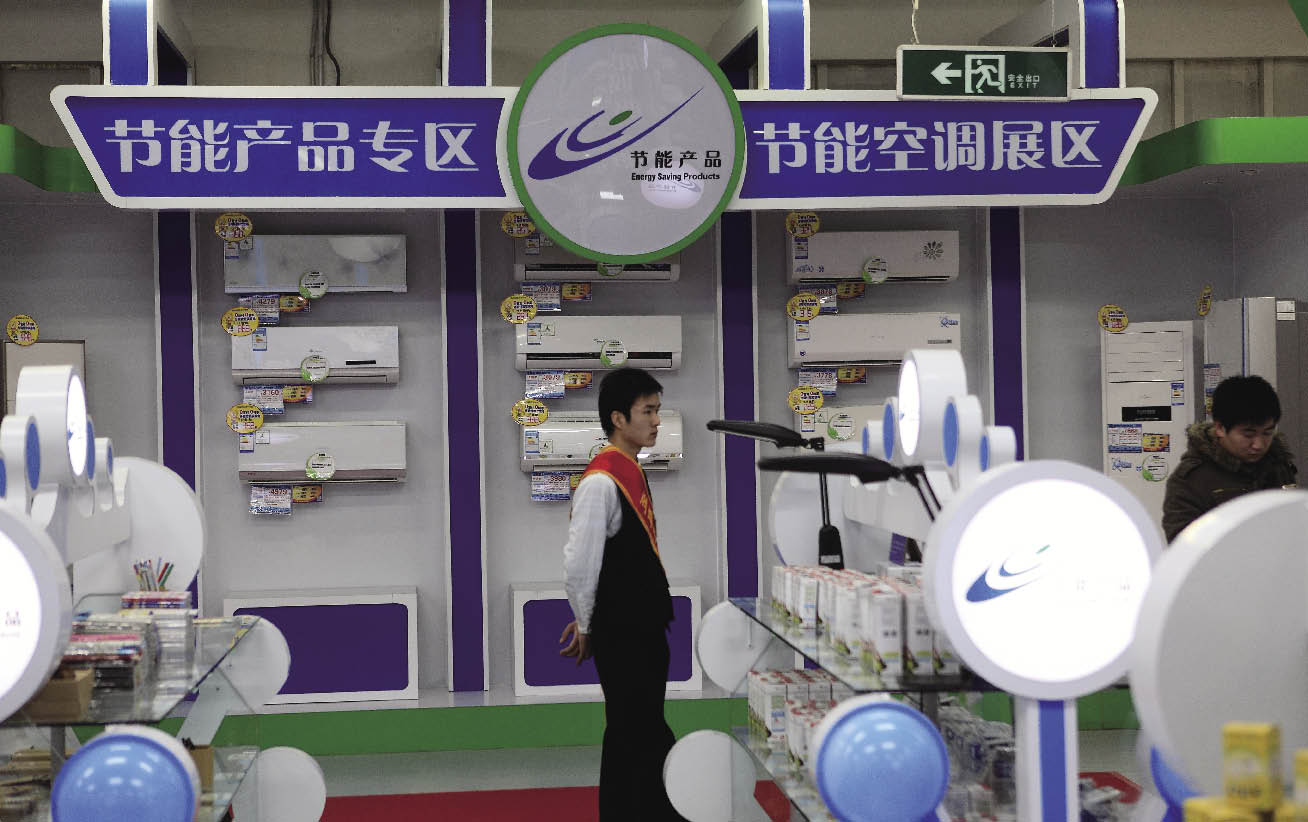
Pushing the “good” life: Energy-efficient products are displayed in high volume areas and often come with subsidies and rebates. China Foto Press |
Commercial Promotion
Wang Zhe and his fiancée were planning on buying a set of household appliances for their new home. At one appliance store, they found that all the products they were looking for, from refrigerators to microwave ovens, were listed as energy-saving products.
A look at TV sets alone shows, without exception, both foreign and domestic manufacturers have launched energy efficient products. In September 2008, Hisense released a LED (Light Emitting Diode) LCD (Liquid Crystal Display) TV, which became one of the first electronic brands to carry the nation's new official "authentication certificate for energy-saving flat-panel TV."
In 2009, several foreign electronics manufacturers summoned news conferences to promote their latest LED energy-saving offerings, which was done in an effort to break into the flat-panel TV market while at the same time conforming to the development direction of energy conservation. Early this year, domestic TV brands like Hisense and Changhong chimed in with their most recent products. "The competition within China's flat-panel TV market in 2010 will undoubtedly be fought in the category of LED energy-saving TVs," pointed out Lu Renbo, deputy secretary-general of China's Electronics Chamber of Commerce.
Some producers have resorted to gifts as a way to promote and encourage people to buy green. TV manufacturer Konka offers prepaid electricity credit cards to consumers who purchase certain energy-saving TVs, equivalent to the amount of one-year's electricity costs for TV usage.
Sellers not wishing to lag behind in their sales, tend not only to consciously place energy-saving products in high volume areas and ensure that their features are well promoted, but also to provide additional stimuli to buyers. For example, as one of China's two largest home appliance retailers, Suning gives subsidies to their customers of between RMB 200 and 800, depending on the product. Its counterpart, Gome, offers rebates to consumers who purchase a certain number of energy-saving products. For TVs, refrigerators and air conditioning units valued over RMB 3,000, the customer is entitled to get RMB 200 back. These subsidies are in place to help offset the cost differential between buying energy-saving products and ordinary ones.
|