|
Zhuang Brocade: State of the Weaving Art
By staff reporter XING WEN
With a population of over 16 million, Zhuang is the largest ethnic minority group in China. Over 90 percent of Zhuang people live in Guangxi Zhuang Autonomous Region in southwest China, and the rest reside in neighboring Yunnan, Guizhou and Hunan provinces. Throughout the centuries, the Zhuang people have been admired for their outstanding brocade weaving skills.
 |
|
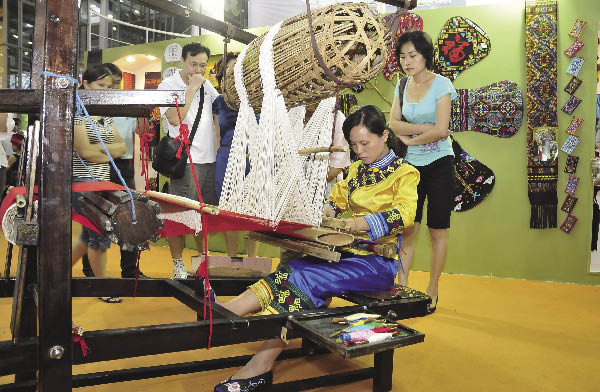
A Zhuang girl demonstrates brocade weaving on a traditional “pig cage” loom at the 5th China (Shenzhen) International Cultural Industries Fair. |
Centuries-long Handicraft
Zhuang brocade has a long history. As early as the Han Dynasty (206 B.C-A.D 220), Zhuang people began to weave banbu, or streaky cloth, which is considered the predecessor of brocade. Several remnants of the cloth were discovered in a tomb from the Han Dynasty in Guangxi, proving the early existence of this weaving technique. As dyeing technology was improved later, the former monochromatic textile became richer in color.
During the period spanning the Tang (618-907) and the Song (960-1279) dynasties, this handicraft took on its defining characteristics, merging the strengths and beauty of silk, fiber and cotton.
Of brocade’s origin, a story handed down from the Song Dynasty tells of Danimei, a female weaver of the Zhuang ethnic group. According to the legend, she amused herself by designing new and fascinating patterns for her brocades. One morning, having spent the whole night sitting in her doorway thinking up new designs, Danimei suddenly noticed the dewdrops on a spider web, which in the morning light emitted all the colors of the rainbow. Danimei was instantly inspired by this amazing effect and moved her loom outside under the eaves. Watching the pattern of the dew-bejeweled web, Danimei began to weave a piece of brocade to mimic it, with multicolored silk threads.
With her deft hands flying up and down without stop, Danimei managed to weave the new design within just half a day.
Seeing the outstanding work, weavers from all around the region came to Danimei’s house to learn her skills. This technique thus spread quickly across places inhabited by the Zhuang population.
By the Ming and Qing dynasties (1368-1911), Zhuang brocade was woven with an even richer pallet of colorful floss and further elaborated in both style and technique. With its fantastic mix of textile strands and hues, richly embellished brocades became one of the special gifts offered by the local authority of Guangxi to royal courts, starting in the Ming Dynasty.
|