| The Rarest, The Best, The Missing
Guanling Fossil Cluster Sparks Controversy
By staff reporter ZHANG XUEYING
 |
|
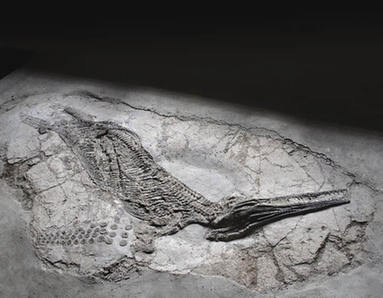
Frankenstein's Fossil: Ichthyosaur had a dolphin's bill, crocodile teeth, lizard's head and breastbone, a whale's four limbs, and fishes' vertebra. Li Xueshi |
A large quantity of well preserved fossils of pre-historic marine life have been found in the strata of the mountainous region in Guanling National Geopark in Guizhou Province. "It looks like their cemetery," commented Zhang Dapeng, curator of the geopark museum, pointing to the staggered array of quiet mountains in the distance that houses their graves. But that's a gloomy view of a geopark that in fact sparks a lot of delight, pride, and some controversy as well.
"The variety is surprisingly rich," said Zhang Dapeng. Excavations began in the 21st century, spreading over 26 square kilometers so far. Archaeologists believe that more massive fossil deposits can be found within 200 square kilometers of the geopark. The unearthed fossils include not only large marine reptiles such as ichthyosaurs, thalattosaurs, and placodonts, but also crinoids, and ammonites.
Ichthyosaur was a huge marine reptile with a dolphin's bill, crocodile teeth, a lizard's head and breastbone, a whale's four limbs, and fishes' vertebra; it is known as the marine hegemon of the pre-historic period. Jiang Dayong, associate professor at the School of Earth and Space Sciences of Peking University, fills us in, "Fossils of ichthyosaur had been found in Germany, Italy, Canada, Switzerland, Britain, the United States and Japan, and the Guanling ichthyosaurs are also not the earliest discovered in China. But they are the best preserved and largest in number found in the world. The size of Guanling ichthyosaurs is also notably huge, generally five to six meters long, 15 meters at the extreme, which is equivalent to the longest animal in the world – the whale."
The archeologists have also excavated fossils of placodonts, which are similar to present-day turtles. The Guanling placodonts are of a large and rare variety. Jiang Dayong feels that more precious yet is the knowledge gained: "The Guanling fossil clusters have filled the gap in geoarchaeology and helped formed a clearer picture of the evolutionary process linking the Triassic ichthyosaurs, the Chaohusaurus found in Anhui, and the ichthyosaur fossils in neighboring Yunnan Province's Luoping County. Furthermore, we can see a clear record of the progress of the Triassic species from meager evidence of their presence in Anhui to their prosperity in Guanling."
The animals in this fossil deposit lived in the Trias, a period between the Permian and Jurassic lasting 50 million years, from roughly 250 million years to 203 million years ago. One of the important characteristics of this period was expansion of the continent, burgeoning reptile populations, and the appearance of marine reptiles. But what caused the death of huge animals like ichthyosaurs? Why did all the living things die simultaneously? Why are their fossils so well preserved?
Even the most delicate life is strangely intact. Crinoid is a tender, invertebrate marine animal in the shape of lily, thus its name "sea lily." It grows upside-down, its roots clinging to floating trees. After death, its jelly-like body would normally be dissolved by sea tides. But here we can see complete fossils including roots, stems and crown, even thin feather-like branches. Jiang Dayong sums up the mystery, "This needs a becalmed sea without a wave or hardly a current. Or, we must conclude these crinoids died in the twinkling of an eye."
To solve the riddle, scholars began to analyze the physical components of the rocks. They found in the fault a stratum whose color is much darker than the light-yellow strata close to it, almost blackish. This shows that it contains charcoal, a typical indicator of an oxygen-deficient environment.
If suffocation was the cause of death, this body of water would indeed be stagnant. If this hypothesis proves true, the Guanling area would have been submerged in an isolated body of water. Guanling is on the Yunnan-Guizhou Plateau in southwestern China, neighboring the Qinghai-Tibet Plateau. Most geologists believe that in remote antiquity this area was under the sea. During the Triassic Period, the continent gradually extended its reach with the slide of crusts. Hence, the seabed rose and the sea receded. Some scholars hold that it may have been during this very period that Guanling became an isolated body of water.
|