| Messages Encoded in Bird-and-Flower Paintings (Part I)
By staff reporter WU BING
THE free-hand painting Liu Zhongxin (1948-) did to celebrate the beginning of a new business has encoded in it best wishes for the proprietor's success in the years to come. A litchi branch loaded with crimson red fruit signifies a prosperous business, for the branch conveys an image that stands for a "line" of business, while the fruit is a play on the word "profit," which in Chinese is a homonym for "litchi." If a rooster is added under the tree, the artist said, the meaning expands to "many blessings and much prosperity."
Chinese painting boasts of many genres, of which the bird-and-flower – either rendered in subtle and meticulous gongbi brushworks or in saturated and splashy expressionistic ink – is just one; but it has a long history that can be traced back to the Song and Yuan dynasties. During that time paintings of birds and flowers were often seen as décor in the homes of the wealthy, or embellishments for folding fan-faces carried by scholars. Still, they appeared almost everywhere in contemporary life, in a residence, restaurant or teahouse, even on cups and plates in daily use. A bird-and-flower composition serves as a vehicle for auspicious messages, which is often reinforced by a homonymic object's name. Almost every kind of bird and flower can serve this purpose.
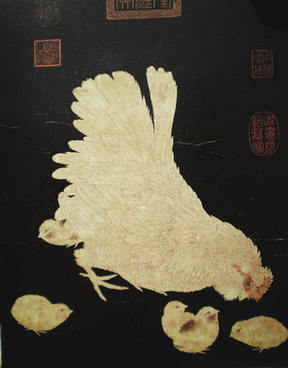 |
| Hen and Chicks by an unknown artist of the Song Dynasty. |
The Five Virtues of the Rooster
Liu Zhongxin, a contemporary artist of the genre has a special interest in painting roosters and these works of his are vigorously sought after on the market. "The rooster is much loved among Chinese people," Liu says, "and many famous artists, like Ren Bonian (1840-1896) of the Qing Dynasty, Qi Baishi (1864-1957) and Wang Xuetao (1903-1982), took it as their favorite subject."
Roosters were a part of all home life at the time and remain closely related to many people's lives in China today. To artists, they are a perennially absorbing subject, because apart from the bird's name being a homophony for "blessing" in Chinese, the fowl has five virtues people admire.
First, it has that very impressive a red crest on its head. Crest, in Chinese, is a homophony for officialdom; the suggestion is a swift rise up the social ladder. Some artists like to do a rooster beside a cockscomb in the hopes of doubling the luck.
Second, the rooster has an extra clawed toe on the back of its leg, which gives its posture an air of confidence, particularly so when it holds its head high and struts around.
Third, roosters and hens are fearless fighters. Facing a predator, the hen will shelter their chicks under her wings while the rooster, all feathers standing up and shrieking like a battalion's horn and percussive section, readies for a fight to the death.
Fourth, roosters and hens are not territorial and disposed to sharing food with others. Finding worms, the rooster will call on his spouse to enjoy the feast together. Hens are devoted mothers, transferring food first to the beaks of her babies. This meets the Chinese standards for generosity of spirit.
The fifth quality is that roosters are alarm clocks that never fail. Over the past several thousand years, they have dutifully awakened the Chinese nation at sunrise, calling them to work regardless of the weather. For this reliability alone, they have been highly regarded. The deserving rooster is often painted standing on a rock doing just this job – announcing daybreak. And that composition means "a new and promising day begins."
|