|
Beauty and Politics
Stars on and behind the stage fuse an ancient Chinese legend with Western opera
By LU ZHU
THE legendary Xishi tops the bill of the "Top Four Beauties of Ancient China." Unlike Helen of Troy, whose face launched a thousand ships – the ten year war with Greece – Xishi used her beauty to secure a decade of peace for her vassal state of Yue. This 2,000-year-old Chinese character graced the stage recently in an opera adapted to the Western form of the art, set for a week-long run in late 2009 at the National Center for Performing Arts in Beijing.
|
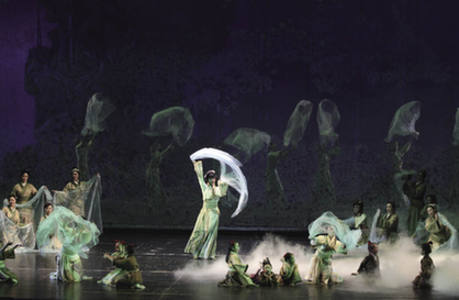 |
| Xishi is the first original opera staged at the National Center for Performing Arts. Cnsphoto |
Opera Taditions Mesh
How to mingle the traditional ingredients of the Oriental story with the alien elements of Western operatic art was a plot and staging challenge; aligning Chinese vocal styles to the melodies of arias was another formidable task for Xishi's creative team. These artistic fusions were believed to be major selling points that would tickle an audience's curiosity and interest in the production.
The curtains rise on a backdrop of a huge traditional ink-and-wash painting that conveys the vastness and serenity of a southern landscape. The tone is immediately set for the audience: this story is unmistakably from the ancient Chinese canon.
Playwright Zou Jingzhi was the principal adaptor of this tale for the stage, drawing on his laurels as a celebrated poet in the 1980s and a popular screenwriter for films and TV plays in the 1990s. Among his lesser known qualifications are his decade-long devotion to Western vocal training and his love of opera. These preoccupations provide him with some strong footing for this recent, and audacious, artistic endeavor.
As the soul of an opera, the musical score is vital to the success of any new stage production. Composer Lei Lei is a heavyweight in the younger generations of China's music circles and has created many works that are perennially popular at karaoke halls. The Xishi arias reflect her sober and inflective music style and incorporate traditional Chinese music elements into the Western operatic formula, such as the use of the basic five-note scale (Do, Re, Me, So and La) of ancient China and Chinese folk instruments. A masterpiece in the style of such mixed elements is the aria set to the lyrics of Choumou, an ancient song from Book of Songs: Tang Ballads. Though no one knows how the lyrics were rendered in performance three millennia ago, Lei Lei has convincingly restyled this tender and tremulous anticipation of the wedding night.
Costumes were designed by Han Chunqi whose creations adorned performers in the closing ceremony of the Beijing Olympic Games. All the elaborate costumes stitched for Xishi represent the haute couture of two millennia past, both in cut and fabric. The opera is directed by Cao Qijing and the orchestra conducted by Chen Zuohuang, both celebrated masters in their respective fields. Audiences are sure to be dazzled by the set designs and choreography.
The cast was no less illustrious. Leading actress Zhang Liping is a Chinese-Canadian soprano closely associated with the Royal Opera London. She is also the first Chinese vocalist to appear at the Metropolitan Opera House, New York. Leading actor Dai Yuqiang is currently China's most celebrated tenor and is also appearing in international stage productions.
|