|
Yao Tianli now holds an administrative position in the Fuzhou-based naval division in Fujian Province. After graduating from the Beijing University of Technology, Yao chose not to look for a job and settle down in Beijing like his counterparts, but instead became the only graduate of his university to join the army. "As far back as my graduation from high school, I desired to enter a military college, but I was unable to at that time. My dream has finally come true." Yao Tianli continues proudly, "The military values and rewards soldiers with better educational backgrounds; I was made lieutenant, deputy company commander upon joining the navy after graduation." Yao was first sent to train at the Dalian Naval Academy of the PLA for one year and later served on a few of the naval fleet's warships. "By taking those assignments, I've moved up the ranks quickly."
New governmental policies have been created to attract the nation's brightest into the service. To university students who perform a two-year compulsory military service, the government offers tuition reimbursement packages, along with student loans of up to RMB 6,000 per year. In Beijing, the annual subsidy for servicemen has been raised from RMB 10,000 to 15,000. Apart from financial support, college students enjoy additional benefits from those extended to the rank and file, like accelerated promotions and opportunities for further education. All of these policies can be attractive to university graduates and undergraduates alike who are now facing employment difficulties resulting from the current economic crisis. In 2009, a total of 15,000 young people in Beijing passed the preliminary examinations, more than half of whom were college students. That figure is four times as many as in the previous year.
 |
|
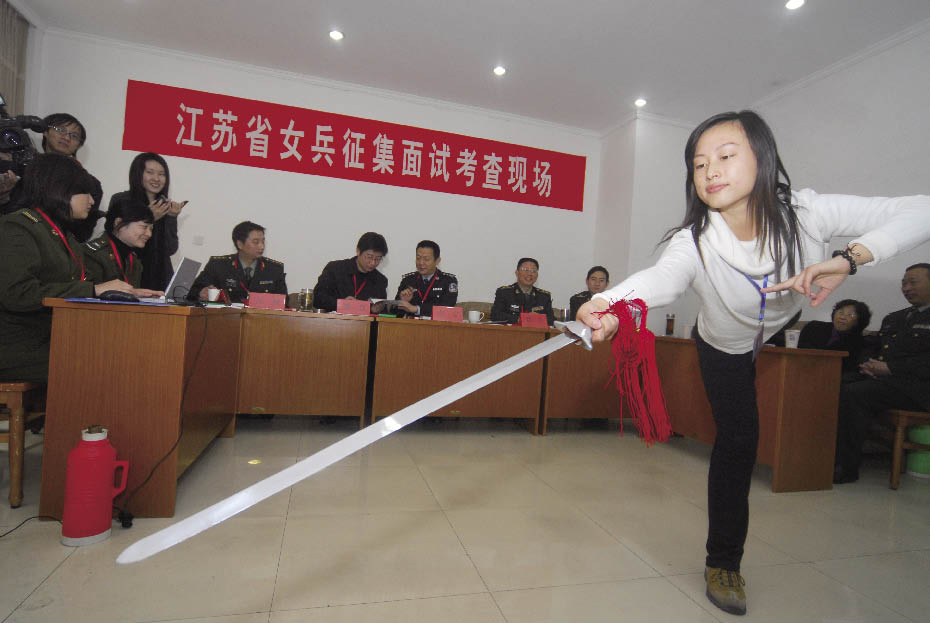
Why live vicariously? So think those who audition for the coveted female spots in the nation's military. China Foto Press |
Not Just a Job
As a staff member at the military drafting center in Junan County, Shandong Province, Wang Changyun witnessed a boom in enlistments in the last two decades of the 20th century.
In his county, most of the applicants were from rural villages. Wang remembers that in the 1980s, a child joining the army was considered a great honor for the family. "At that time, young men from the countryside were rarely able to enter universities. Therefore, serving in the army was the ideal way to make a better life in an urban area. Besides, servicemen were always placed in good jobs after they retired from the army." Wang himself was transferred to a position in the county government after completing his military service.
However, as China's economy developed quickly at the end of the 1990's, rural youth found themselves exposed to alternative opportunities for a better life. Apart from a greater access to higher education, large numbers of villagers began flocking to big cities to take work in areas of demand. Meanwhile, the chances of getting a job with a government department became slimmer, making joining the army less attractive to young people.
"But the situation has changed since then," says Wang Changyun. "Soldiers have been enjoying much higher salaries in recent years. In some places, incomes for servicemen can be higher than their civilian peers."
For parents, however, their children's military experience means much more than basic monetary rewards.
Mrs. Sun, a resident of Beijing, sent her only son off to Inner Mongolia for his military service in 2005. "He was always hanging around with the wrong kind of people after his graduation from high school. I was so worried about his future during that period." To Sun's delight, after returning from his three years' service, her son had become thoughtful and sensible. "Now he has found a decent job and is living a peaceful life."
Recent graduate Liu Jingsheng from Beijing University of Science and Technology, along with dozens of his schoolmates, sent in their applications to join the military last month. Liu's father, a veteran, often fondly recounts stories of his military days to his son. The father believes that young people today lack the strength and toughness that his generation possesses both physically and mentally. He is convinced that the discipline of the army, as well as its spirit of gallantry, would be character-forming for his son. |