|
Thriving Performing Arts Market in China
By staff reporter ZHANG XUEYING
WE need more laughter to survive the depressing economic situation," says Wang Ying, marketing director of a creative culture company. "You see comedy has now become the most popular film genre in the cinema. Even drama, which used to be unpopular in places like Shenzhen, now wins great acclaim and even finds success at the box office." Wang Ying goes on to say, "People in difficult situations desire the arts, performances that will bring them joy and help them to forget their cares and woes."
Wang Ying noticed that since the last half of 2008, tickets for the drama performances she planned all quickly sold out. "We no longer worry about facing a deficit."
Not only in Shenzhen, but across the whole country the performing arts market seems to be thriving. When famous Hong Kong singer Andy Lau held concerts in Shenyang and Changsha last March, ticket sales went far beyond the organizer's expectations. The Jackie Chan and Friends Concert held last May in the Bird's Nest stadium in Beijing attracted an audience of over 50,000 people, easily recouping the costs of the show just on box office receipts alone. In July, the renowned dancer Yang Liping made an impressive box office showing with her latest performance The Sound of Yunnan. The tickets were sold out a week before the show opened.
Top-notch Performance Ensures Box Office
Yang Liping still believes that only a good performance can ensure box office. She spent a year in Yunnan Province to find inspiration in the landscape to prepare her work The Impression of Yunnan. She also visited Tibetan areas several times to choreograph Tibetan Mystery. Yang Liping evaluates herself as "having a taste for art with the courage to innovate." Her rich experience as a dancer has helped make her sensitive to the desires of the audience and the needs of the organizers. She always tries to view her work through the public's eyes. "Any details that do not maintain the atmosphere I wish to create must be improved and any part that is less than inspirational should be abandoned," Yang Liping believes.
Yang considers dancing as her life and cannot bear to have any imperfections in her work. Though The Impression of Yunnan has already been performed for over five years, she continues to polish and improve it like an organic piece of art. The Sound of Yunnan is her third dance drama. Over 40 major companies showed their interest in being a part of it – even before it was completed.
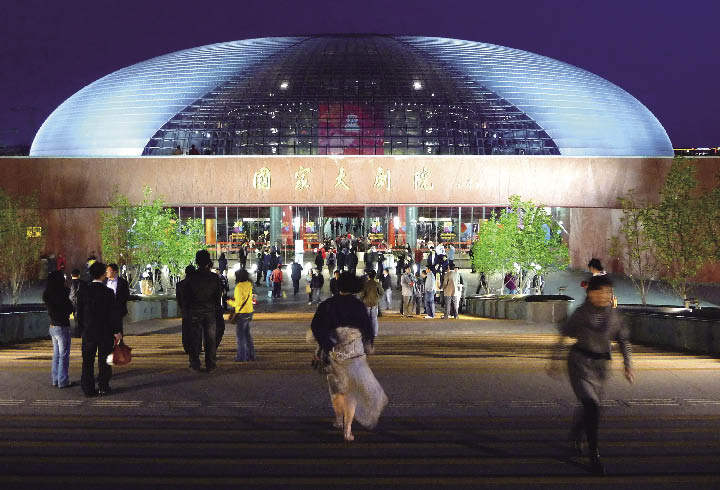
The National Center for the Performing Arts is another shining example of the thriving performing arts market. The Opera Festival that took place from April to July continually played to 88 percent-full houses. Deng Yijiang, spokesman for the National Center for the Performing Arts, says frankly: "Opera is an adopted art that still has an aesthetic distance to reach the general public, so we didn't expect too much from the box office." Music reviewer Liu Xuefeng thinks the unexpected success is due to the famous players and opera troupes. "The first-class performances represent the developing trend in opera." Leo Nucci, the world's greatest Verdi baritone, was invited to play Rigoletto during the opera festival. He found himself deeply moved by the Chinese audiences' passion and got down on his knees for the curtain call. The master decided to perform again in China in 2010. Audiences were also treated to the modern opera brought by the Teatro La Fenice (The Phoenix) from Italy. They performed the classic opera Madame Butterfly in an avant-garde style.
 |
|
Low-priced tickets lead more people to theaters. China Foto Press |
Art on a Budget
According to Deng Yijiang, the low-priced tickets are one of the strategies to win over the market. Tickets under RMB 100 still sell best across every type of performance. Most regular people feel comfortable buying tickets at the price of around RMB 80 to enjoy a performance in the new National Center for the Performing Arts.
The financial crisis that swept over the world in recent years has deeply influenced the global performing arts market. Performance groups throughout Europe and America have had to cancel some tours to reduce expenses. "It is good news for China," Lin Hongming, general manager of the Shanghai Oriental Art Center, points out. "The downturn allows for a more refined selection of acts, maybe higher level. On the other hand, the acts are willing to play for less, due to our cuts in ticket prices, and reductions in the number of performances, but the overall understanding is that the quality will be maintained." The average ticket prices for foreign acts performing in China's mainland tend to surpass those in Hong Kong, London, New York and Tokyo. The tickets for Sarah Brightman's last concert were priced between RMB 800 and 1,000 in Japan. Though the same tickets in Beijing were priced between RMB 380 and 2,000, with the amount of the low-priced tickets being far less than the high-priced, the average price was nearly RMB 1,000. As the per capita income is lower in China (RMB 13,786 in 2008, according to data from the National Bureau of Statistics) than in developed countries like Japan, U.S. and Britain, that adds up to an even bigger gap in the ticket value.
|