| Work Worth Doing: From Honorable to Profitable
By CHEN SI
THE social and economic evolution of China over the past 60 years has brought many changes to how Chinese people view work, and the personal matter of selecting an occupation or calling. Initially, occupations fell into a kind of scale, rising from initial positions as workers and servicemen, to businessmen, entertainers and intellectuals. In more recent years, the social and technological advances of the new economy have increased the demand for skilled and creative work, new and transferred technical specialities, and emerging public service roles. A so-called "good job," based on purely political and social factors, is a notion that has had to move over as Chinese people enjoy more freedom of choice. Multiple standards, including economic factors, now carve out the territory of work worth doing. Options in career paths have never been greater.
Once Honorable Jobs
The working class became master of the country after the founding of the People's Republic of China (PRC), and non-rural workers increased rapidly. Two factors, stability of employment and high social status and earnings, made being a "worker," especially one in a state-owned enterprise, simply the most sought-after occupation.
Industrial workers have been the backbone of the country's enterprises, manifesting intense responsibility to their progress, and that of the country. Meng Tai from Angang Ironworks built the famous "Meng Tai Warehouse" by collecting thousands of scrapped parts that later played an important role in reconstructing Northeast China when the factory resumed its production during the Liberation War. As China's first group of oil workers, Wang Jinxi and his fellow workers drilled the first oil well in Daqing, Heilongjiang Province, ending China's oil-poor reputation and setting a world record of 100,000 meters drilled in one year.
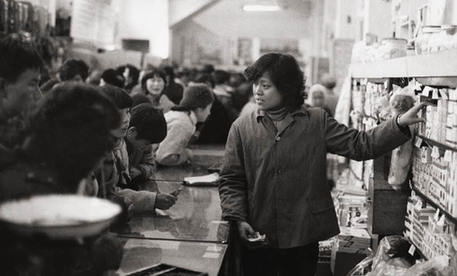 |
| Sales clerk was a sought-after job in the years of material shortage. |
Soldiers were looked down on in the old society, revealed by the saying, "Good iron doesn't make nails; true men don't make soldiers." After the PRC was founded, to be part of the armed forces became the dream of many young men. "Who Is the Most Lovable," an article on the heroism and revolutionary spirit of the Chinese People's Volunteers serving in the Korean War, influenced generations of Chinese people. Many excellent servicemen have become idols in their time. After being demobilized, military men and women enjoyed high social status, greater educational opportunities, andgreater latitude in career choice than others. Moreover, to marry an officer was many a girls' dream then.
Cadre was also an admirable position. In times when ideology was paramount, to be an official was very popular, especially where political work held a cadre responsible for people's ideological development. In years of material hardship, those professions that bridged people with relief in the form of grant coupons, or were engaged in food distribution, or put people close to leaders on a daily basis (such as a driver), were highly desirable.
Interestingly, the most hapless occupation was probably the intellectual. Before China's reform and opening-up in late 1978, they were satirized as "stinking ninth grade." This label, given during the "cultural revolution" (1966-1976), stems from the 13th century when the Mongols ruled the country and the populace was sorted into ten social strata. The intellectual was superior only to the beggar and inferior even to a streetwalker. From 1966 to 1976, large numbers of intellectuals were transferred to do manual work in the countryside.
|