| Archway Anecdotes
By HUO JIANYING
THE paifang, a stone or wooden arch, is a unique element of ancient Chinese architecture. In feudal times, it was erected as a monument in memory of anyone – dead or alive – who had rendered meritorious services or lived a life embodying exalted human virtues. Typically these were accomplished generals, scholars and administrators, and even widows who remained celibate in honor of their dead husband. Paifang were also built as ceremonial entranceways to sacred places such as temples and mausoleums, and finally served humble purpuses as road signs, where they dominated neighborhood entrances and indicated an area's name.
A pailou is almost the same as a paifang, except for architectural details. A paifang usually comprised a single row of pillars spanned by cross beams, with or without panels in the crisscross beams and pillars above an arch or arches. A pailou ("lou" means "tower"), as the name suggests, imparts a sense of grandeur. It is usually larger and higher with dougong (overlapping bracket lock) roofs.
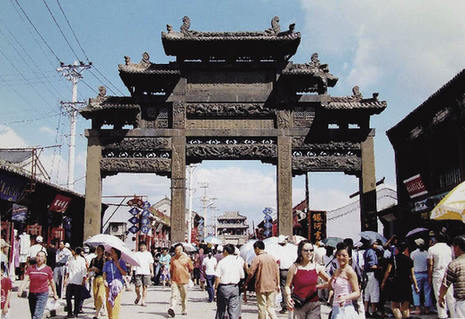 |
| The stone arches dedicated to the Zu brothers in Liaoning's Xingcheng. |
Military Arches
Two carved stone paifang of the Ming Dynasty (1368-1644) still stand in present-day Liaoning's Xingcheng (ancient name Ningyuan). They were erected by the last Ming Emperor Chongzhen to honor two brother generals, Zu Dashou and Zu Dale, for their military feats fighting Manchu invaders. The arches are testimony to the masonry achievement of the 17th century, as well as an era of dynastic change.
Each of the paifang has four pillars, forming three arches topped by five escalating roofs. They are 11 meters tall, and stand 85 meters apart at either end of a street. Besides inscriptions, the southern one, dedicated to Zu Dashou, is carved with fighting scenes, while the northern one dedicated to his brother is inscribed with flowers and auspicious animals.
Zu Dashou was from a dynastic military official family in Liaoning's Xingcheng, and his outstanding military services saw him become chief commander of the vanguard troops stationed in eastern Liaoning. He was the most competent general of Yuan Chonghuan, the late Ming's chief commander in the campaign against the Manchu invasion. Later, Zu followed Yuan into the capital to protect the frightened emperor, where, unfortunately, Yuan was framed and put in prison on charges of "betrayal and conspiracy with the enemy." Indignant, Zu led his troops out of the capital and headed for his home via the Shanhaiguan Pass. Yuan Chonghuan wrote to him from prison, persuading him to return to his duty. Zu's mother also wrote to her son, asking him to fight the invaders, and hopefully save his chief commander. Zu answered their appeals and returned, but Yuan was killed by the emperor nevertheless. Later, Zu led the troops of Yuan Chonghuan – the most competent fighting force of the Ming Dynasty – to guard Ningyuan, Jinzhou and Dalinghe on the northern frontier against invading Qing troops.
In 1631, Zu and his troops were besieged in Dalinghe City for three months by the Qing army. After Qing commander Huangtaiji swore that he would not kill any surrendering soldier, officer or civilian, the helpless Zu Dashou opened the city gate. Then Zu suggested to Huangtaiji that since his wife and family were still in Jinzhou, he lead troops disguised in Ming uniforms into the city to assist the Qing troops' attack and capture of the city from within. Huangtaiji agreed and gave Zu 5,000 troops. On his way, Zu stole away from the Qing troops in heavy fog. He went alone to Jinzhou, where he led the Ming troops in ongoing resistance against the invaders. Emperor Chongzhen then ordered erection of a paifang to console the loyal fighter and guardian of his dying dynasty. Zu guarded the frontier of the Ming Dynasty for another decade until its downfall in 1644.
|