|
Ma Jihui has just finished a work for an exhibition marking the first anniversary of the quake, a larger embroidery expected to bring her an income of RMB 600 to 700. In the new village under construction near the tent zone where Ma Jihui and her fellow villagers have been making do, each house will have a front courtyard to grow vegetables and fruit trees, and a backyard to build a kitchen, a toilet, a methane pit and a pig pen. The roofs will be decked with the customary white rocks used in Qiang domiciles. An aid group from Jiangmen City is working on a 13-km pipeline to funnel water from the mountain to every household, which when completed in May, will put an end to locals' thousands years of manual toil.
 |
|
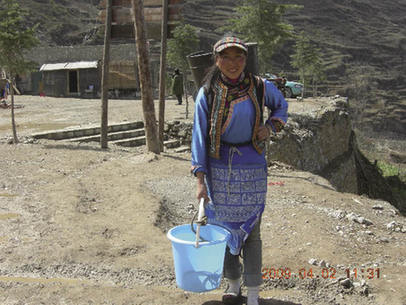
Before the water supply is reconnected, Luobozhai villagers have to fetch water from the mountain. |
The Only Shibi in the Village
On May 12, 2008 Wang Mingjie became the only Shibi left in Luobozhai. A Shibi is the flamen and wizard in Qiang society. A people without a written language, they hand down their culture and accumulate knowledge through chantings and rituals Shibis inherit from their predecessors in that role. That's why the fate of Shibi and their viability in Qiang culture has drawn wide attention in the aftermath of the seismic calamity.
The only other Shibi in the village, 92-year-old Zhang Fuliang, was killed in the quake, and the most important item of his ritual practice – a monkey skull – is still missing. "It was brought out in public only for the sacrificial ceremony on the Qiang New Year. After every use, it was rewrapped with a fresh layer of white paper. It is more than 600 years old now," lamented 69-year-old Wang Mingjie.
As the news spread that the old Shibi was dead and the monkey skull and many other ritual objects were lost, general angst reigned in the region. In the locals' faith, the souls of the dead should be ritually pacified using particular relics of this sort.
Fortunately, a frantic search of the ruins uncovered some essential Shibi objects, including a sheepskin drum and trident cap. At the sight of them, Wang Mingjie fell onto his knees, repeating thanks to his predecessors in heaven. Other villagers jostled to kiss the retrieved items in ecstasy. Like other Shibis, Wang has committed to memory a scripture in three parts: the first accompanies offerings made to the mountain and expresses gratitude for fulfilled wishes; the second is for appeasing the gods, dispelling evil spirits and soliciting blessings for weddings; and the third, for which Wang Mingjie had not learnt the full content before the death of the senior Shibi, is a prayer for the deceased of violent death.
In the tradition of Shibis before him, Wang Mingjie is a part-time pastor and full-time farmer – in his case, tending a maize field. When called upon, as in the wake of this tragedy, he puts on his robe and hat and performs the ritual dances of his heritage, accompanied to beats from the old sheepskin drum. Then, transformed into a man of extraordinary sanctity and solemnity, he channels the healing power that binds the past and the present, the living and the dead.
|