China produces tens of thousands of scientific and technological research outputs every year, but how many of them can make it out of the lab and into the market? And how difficult is it to cross the so-called “Valley of Death” in the industrial application of technological advances? With these questions, the reporter visited several Chinese tech companies engaged in the proof-of-concept development, lights-out laboratory testing, and industrial ecosystem building. There, the reporter tracked the journey of research outcomes from blueprints to factory floors.
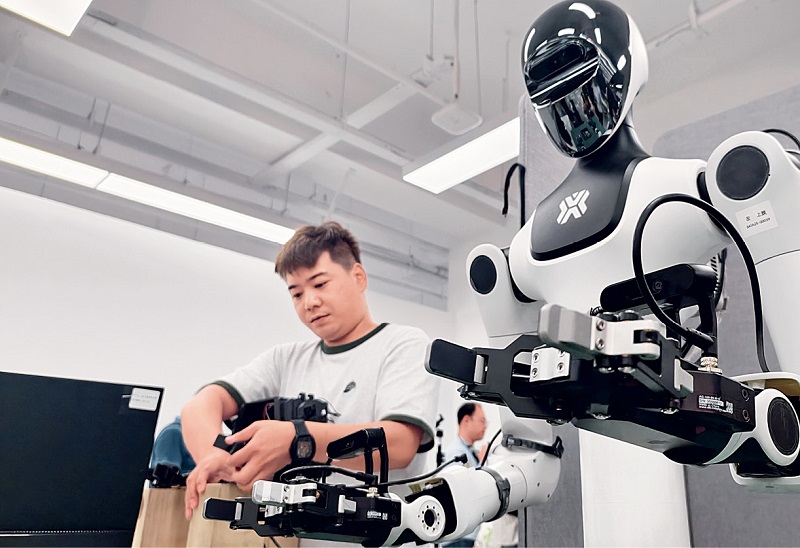
The embodied AI robot data and training base of Beijing Innovation Center of Humanoid Robotics Co., Ltd., a full-stack technology company specializing in embodied AI hardware and software.
Pilot-Scale Testing
Yulitech, based in the Fengtai District of Beijing, is one of China’s first technical service providers that specialize in proof-of-concept and pilot-scale testing. Pilot-scale testing is the intermediate stage between laboratory research and mass manufacturing; the process to verify the design and application of a technological procedure. According to an executive of Yulitech, many promising research ideas were “killed” at this stage, because the professors who put them forward often lacked knowledge of the manufacturing processes and cost control. Going directly to production line from laboratories, the success rate for industrial application of technological advancement is only 30 percent. With pilot-scale testing, this rate can soar to 80 percent. This is why such trial runs are critical for translating research results into practical products.
At Yulitech, the showroom is crammed with a dazzling array of prototypes, including barcode scanners used at supermarkets, computed tomography (CT) machines for hospitals, smart combs for daily use, brain-computer interface hardware, lunar test instruments, smart sensors, robotic joint modules, medical diagnostic devices, and industrial control terminals. Each of them tells a story of transformation from academic papers to tangible products.
“Many laboratory achievements are just one step away from mass production. Our job is to bridge this gap,” said Yulitech founder Li Xujin. Over the 12 years since its founding, his company has served more than 1,000 businesses, institutions, and research organizations, bringing nearly 4,000 self-developed models to market and producing more than 36 million units or sets of end products.
Pilot-scale testing allows developers and investors to gain a better understanding of technological advances and consequently make informed decisions. Take Yulitech’s collaboration with Tsinghua University on a surgical robot project as an example. Through testing, the company’s technology team optimized the mechanical design and found a modular solution based on market research, reducing product costs by 40 percent. It also assisted with certification for the medical device and connection with investors.
“Yulitech’s professional design of intelligent terminals and pilot-scale testing services can not only help good ideas cross the ‘Valley of Death,’ but also significantly reduce the time and cost of putting them into real products. We can even leverage our supply chain to directly help customers reduce costs and improve efficiency,” said Xu Xuezong, partner and deputy general manager of the company.
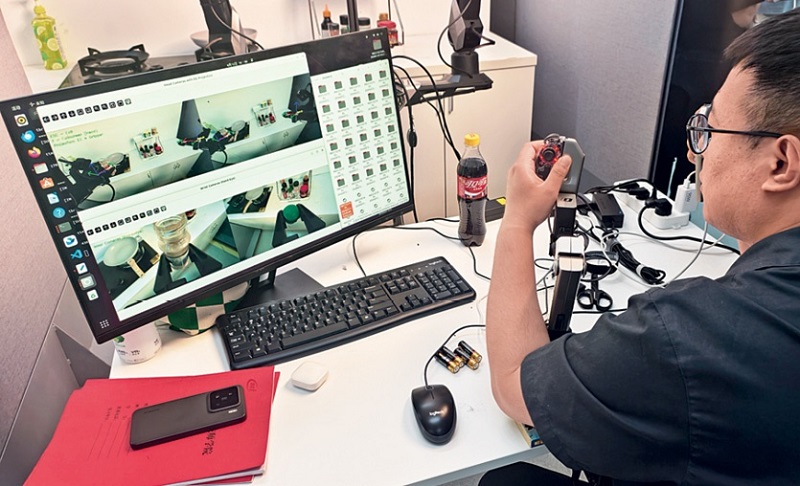
Real-world robot data is critical for the extensive application of AI across various fields.
Lights-out Laboratory
An AI-powered lights-out laboratory sounds like something out of a sci-fi movie, but it is already up and running at Dynaflow, another tech company located in the Fengtai park. In its exhibition hall, Chairman Chi Haipeng introduced the reporter to a completely unmanned, automated research environment. There, AI models deeply integrated with advanced laboratory instruments can operate 24/7 without interruption, autonomously completing the entire workflow, including sample processing, experimental operations, data analysis, and report composition.
If Yulitech solves the problem of “how to make it,” Dynaflow tackles the issue of “how to make it faster and smarter.”
“The system also has the ability to learn and evolve for iterative improvement. With no human involvement throughout the entire process of 24/7 continuous operation, it relies on AI technology for tasks such as path design, sample processing, instrument control, and result analysis,” said Chi, adding that scientific research is shifting from the traditional experience-driven approach toward the intelligence-driven mode. With its innovations, Dynaflow frees researchers from repetitive manual labor so they can focus on creative work. Its solutions have been applied across multiple cutting-edge fields, including materials, energy, and life sciences.
At Shenghong Petrochemical in Jiangsu Province, Dynaflow’s solution is deployed in an acrylonitrile testing laboratory where 87 precision instruments and 56 robots work in coordination. “The lights-out laboratory runs on an autonomous system, completing the entire testing process in just 3.5 hours. It performs approximately 1,600 autonomous tests on highly toxic samples and more than 5,000 analyses every day, reducing the workload of personnel by half or more,” Chi said.
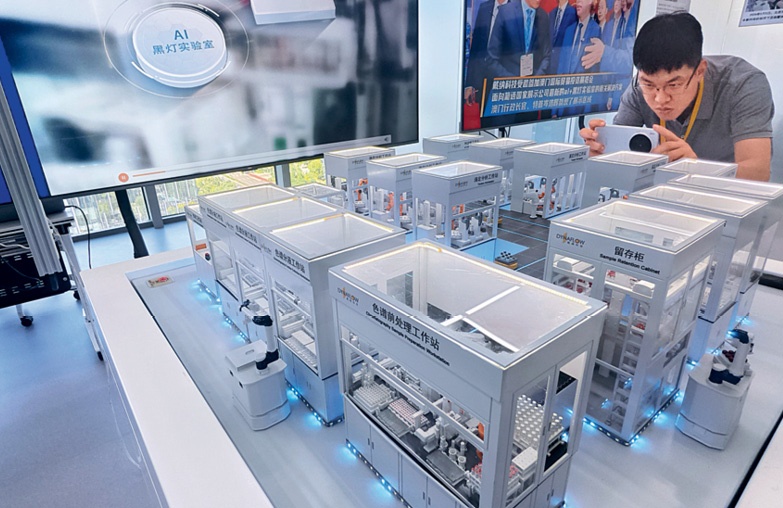
The AI + lights-out laboratory is now a reality in Dynaflow, a tech company located in the Fengtai section of the Zhongguancun Science Park.
Self-Dependence
At its exhibition hall in the Beijing Economic-Technological Development Area, HollySys Group proudly displays the many “firsts” it has achieved, including China’s first domestically produced real-time distributed control system, first digital control system for large nuclear power plants, first integrated rail transport monitoring system, and first large-scale programmable logic controller system. Over the 30-plus years since its founding, this company has marched at the forefront of China’s industrial automation sector and helped the country to master core technologies in this field.
“Our mission is to ensure China’s industrial chains are self-supporting and risk-resilient, and safeguard our country’s industrial security,” said HollySys Chairman and Co-President Xu Yue. Today, the company’s control systems are serving over 40,000 customers in more than 90,000 projects spanning the fields of thermal power, nuclear power, petrochemicals, rail transport, and other sectors that are vital to the national economy and people’s livelihoods.
One of these projects is Sinopec’s 1.2-million-ton-per-year ethylene plant at Tianjin Nangang, a key national project under China’s 14th Five-Year Plan. The polyolefin elastomer unit at this facility has adopted HollySys's distributed control system, which is entirely domestically-developed and produced, from chips to software.
When the Togtoh power plant of Datang International Power Generation Co., Ltd. launched an upgrading project in 2014, it replaced a foreign-brand distributed control system with one from HollySys after a smooth 168-hour trial run. The largest thermal power plant in Asia has since had a “Chinese brain.”
In the transportation sector, HollySys’ train control systems have been deployed extensively in high-speed trains. For instance, the train serving the 2022 Winter Olympics along the Beijing-Zhangjiakou Railway was empowered by HollySys’ radio block center, interlocking, and other smart technologies. It was the first in the world that ran autonomously at the speed of 350 kilometers per hour. During its 55-day service, it operated without a single failure.
Over the past three decades, HollySys has focused on replacing foreign technologies with homegrown alternatives. Now, it is redefining how industrial software is built. In June 2025, HollySys unveiled the XMagital, a freely definable system for integrated intelligence. Users only need to express their requirements in normal language, and XMagital can automatically break down the tasks, match them with corresponding capabilities, design workflows, and ultimately produce a viable industrial application.
“It changes the creation of industrial software from ‘hard coding’ to ‘free definition,’” said Xu Yue. At the core of this system is an industrial world model called XWorld, which integrates process knowledge, operational experience, and parametric standards, enabling it to understand the business logic behind professional terminology. From requirement input to the generation of an intelligent agent designed for that requirement, the entire process is automated, completed without the help of any professional programmers.
XMagital marks a major milestone in HollySys’ innovation journey and a pivotal step in the evolution of industrial intelligence. As a truly user-defined smart system, it significantly lowers the technical and financial barriers to building, operating, and upgrading intelligent infrastructure.
At the smart factory of Hebei Wenfeng New Materials Co., Ltd., this system removes the data silo between the control system and information system. At the synthetic ammonia plant of Yonfer Agricultural Technology Co., Ltd., it enables fully automatic boiler operation while reducing energy consumption and lowering emissions. “This is not something that any company can accomplish on their own,” Xu said. “We hope XMagital can become the infrastructure for intelligent industries, just like the operating system on mobile phones. With it, more people can develop their own applications. Our ultimate goal is not just fostering self-supporting and risk-resilient industrial chains, but building a robust industrial ecosystem.”
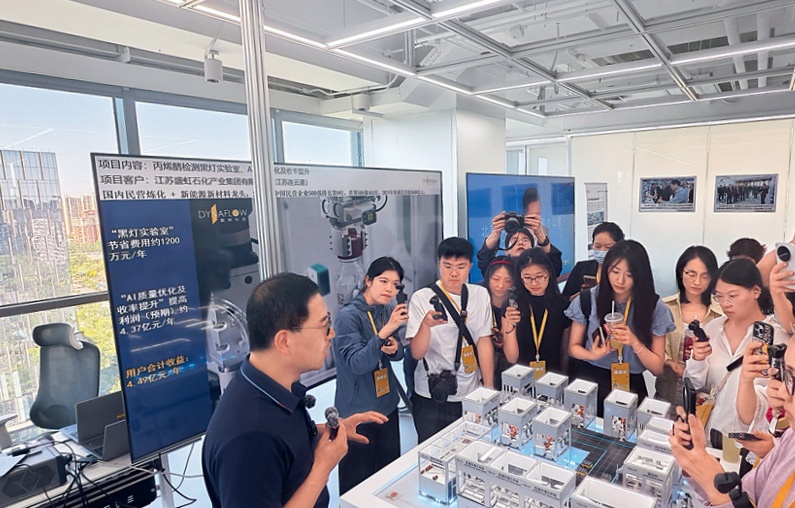
The AI + lights-out laboratory provides a completely unmanned, automated research environment.
Why is the commercialization of technological advances so difficult? Because the laboratory and the market operate on entirely different rules: scientists pursue novelty, while businesses prioritize certainty; academic papers stress originality, whereas products are valued for reliability. The chasm between these two worlds creates the “Valley of Death” that prevents many research ideas from materializing into tangible products.
Beijing’s solution to this challenge is to cultivate a group of “bridge-builders” – companies like Dynaflow and Yulitech that focus squarely on the intermediate stages of experimental validation, pilot-scale testing, and engineering application. At the same time, the city also encourages the development of “chain-leaders” – enterprises like HollySys that drive entire industrial chains toward greater self-reliance and technological autonomy. Innovators, bridge-builders, and chain-leaders together form a healthy industrial ecosystem, where each player makes their due contributions, bringing technological advances to market application at high efficiency. 
WANG ZHE is a journalist with China Report.