| Stewed Fish Head with Tofu
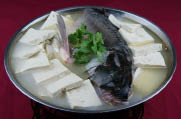
Emperor Qianlong of the Qing Dynasty reigned from 1736 to 1796. A conscientious ruler who took a personal interest in the wellbeing of his subjects, Qianlong made several trips incognito to the southern regions to see how the common people fared. While in Hangzhou on one such visit he got caught in a noon-day cloudburst while climbing Wushan Hill, and took shelter under the eaves of a nearby cottage. As the rain showed no sign of abating, and he felt cold and hungry, the disguised emperor asked the householder if he could come inside and share a meal with him.
The poor tenant of this humble dwelling, called Wang Runxing and nicknamed Wang Xiao’er, was a warmhearted, friendly man. He picked the spinach growing in his courtyard, getting drenched in the process, and fried it with some tofu. After hunting through his larder he found a fish head and stewed it with the tofu that was left. The fresh colors and wholesome flavor of this dish refreshed, nourished and impressed the disguised emperor. By the time he finished his lunch the sky had cleared. After taking note of Wang Xiao’er’s name, the emperor then left.
On his return to the imperial palace, Qianlong asked his royal chefs to prepare the two dishes. But despite their expertise, they could not produce a flavor that compared with Wang Xiao’er’s cooking.
On his next visit to Hangzhou, Qianlong remembered Wang Xiao’er and the delicious lunch he had eaten at his house, and summoned him. On hearing that Wang Xiao’er was out of work and deep in debt, the emperor presented him with 500 taels of silver, and suggested he use it to open a restaurant. Qianlong then inscribed a plaque with the characters “Huang Fan Er,” meaning place where the emperor had dined. Wang Xiao’er was overwhelmed at finding out that the wet and hungry traveler he had fed and sheltered was his lord. He lost no time in opening an eatery and hanging up Emperor Qianlong’s inscription. Stewed fish head with tofu thus became the specialty of Wang Xiao’er’s restaurant.
News soon spread of Emperor Qianlong’s favor, and crowds of local residents came to try the dish that had so delighted their monarch. Before long, Wang’s restaurant became the best known in Hangzhou, and chefs from other establishments apprenticed themselves to him just to find out the secret of his famous dish. Wang gradually added ingredients and refined his stewed fish and tofu specialty until it became one of Hangzhou’s signature dishes.
So, how do you cook this dish fit for an emperor?
1. Clean a silver carp, cut off the head and a section of the meat and soak in boiling water for a few minutes. Drain, slit the jaw and flatten the head, and stuff with thick broad-bean sauce.
2. Slice the tofu into 10-mm-thick rectangles, and flash boil;
3. Pour some vegetable oil into a wok, heat to 70 or 80 degrees and brown the fish head. Pour off the oil;
4. Cook the fish head in a mixture of Shaoxing rice wine, soy sauce and sugar. Turn over and add about 750 ml of water. Add the slices of tofu and some chopped bamboo shoots, mushrooms and ginger;
5. When the dish comes to the boil, transfer to a clay pot and allow it to simmer for another 15 minutes. Increase the heat to maximum for another two minutes and turn off.
6. Skim the surface, and add sections of garlic shoots to the pot. As a finishing touch, add a knob of lard. Serve from the clay pot.
|