| Muse, Music, Musings
By staff reporter PENELOPE COLVILLE
 |
|
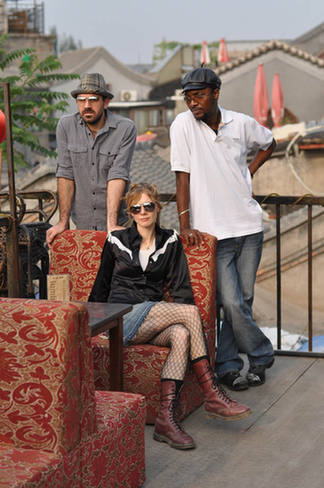
Ember Swift and core Beijing band members Zac Courtney and Paplus Ntahombaye. |
EMBER Swift seems to be a walking collection of improbabilities and contradictions, which probably means she blends seamlessly into modern China. She is a white, foreign female singing original lyrics in both Chinese and English, an avid gardener who lives in China's capital fortress of 18 million people, and a Canadian activist who is living with integrity in China's political reality. Best of all, and lucky for us, she is a songwriter/singer/musician who came to China to get away from the Western music business, and instead made an award-nominated new album with her Montreal-based producer and Toronto band – all while acclimatizing to Beijing.
Ember Swift is her real name. Connoting fire and speed, it fits a pre-pubescent songwriter who recorded her first album as a university undergraduate. But her recent turning-point album Lentic refers to living in still waters. Swift's latest music, already deemed eclectic, is also the product of polemic relations, in a style some reviewers call "folktronica" – acoustic and traditional with electronic beats and grooves. Swift calls it multi-styled, message-based music with various world music influences, going from folk to jazz to funk to rock. And if you'd expect the music that defies categories to somehow synthesize her geographic/cultural identities, you'd be right; the new album Lentic has been described as a sonic tribute to both countries, China and Canada, with musical elements that resonate with the traditions of both Eastern and Western listeners, while at the same time sidestepping those traditions.
When Swift decided to head to China, she was a 32-year-old band leader and musical success, booked a year and a half in advance, running her own label and employing five people to help her manage her career, not to mention keeping agents, managers, and publicists busy. Her colleagues got six months notice of her intention to study the Chinese language in Beijing, but anyone aware of her academic credentials might have figured her degree in East Asian Studies (University of Toronto) was hardly evidence of a mild and transitory interest. By 2007, with nine albums to her credit, she made the break. Now she is writing songs in Mandarin and English, and songs with versions in both tongues.
Swift isn't so much an artist reconciling disparities as a spiritual and quotidian alchemist; she's forging a new life in the East with the expectation that complexity will work in her favor and in which denial and compromise aren't getting much purchase, as usual.
|