|
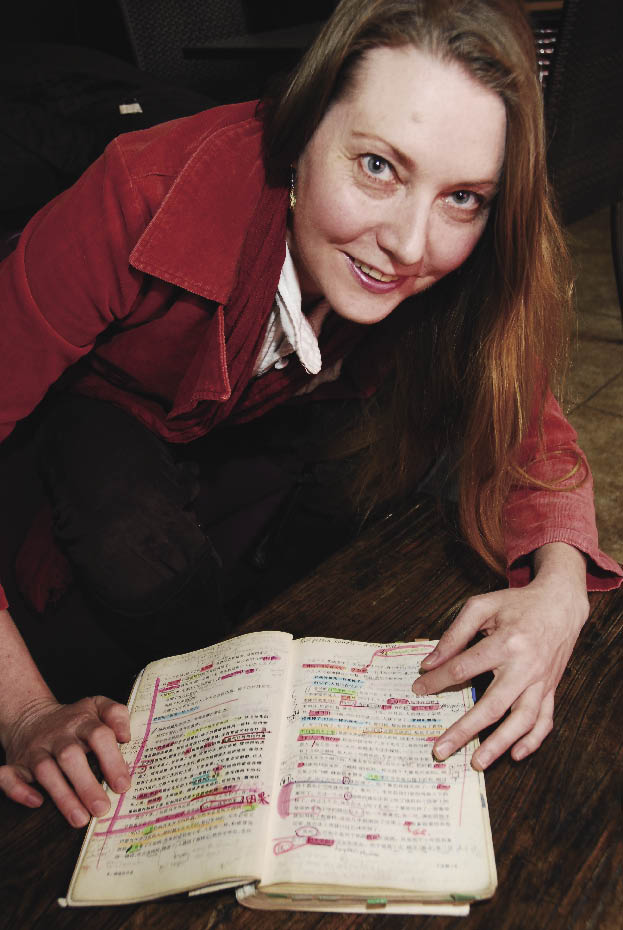
Using the margins: Paper republican cindy carter shows a bit of her translating handiwork.
Carter, like all translators apparently, does what we were taught not to do at school – she "defaces" books and writes in the margins. But her working style may not be typical of translators. A native Californian, Carter studied at the University of California, San Diego, doing a double major in Political Science and Economics with a minor in Japanese. After she graduated in 1991, she lived in Osaka, Japan, from 1993 to 1996 then made the move to China to study Mandarin. This is not a background that would signal a visual person, but she is. It is usual to print a copy of the original Chinese double or triple spaced, to allow for note-taking and citing multiple sources of translation. Carter adds colored pen highlighting to signal her own layers of questions, issues and meaning; they turn the text into an artifact that would delight any mind mapmaker or modeler – or at least ease the conscience of people who "deface" their books by writing in the margins.
Carter uses her blog on paper-republic.org to spread the word about the literature and put pleasant pressure on publishers. Paper Republic is a collective of translators in the process of bringing out online translations of works by authors they all admire, including Li Er. She, Eric Abrahamsen and Brendan O'Kane co-founded the Paper Republic in 2007, and were soon joined by over a dozen translators, based in China and overseas.
However, all we readers and listeners get is the end product; just when we are suspending judgment and allowing ourselves to be persuaded of something by someone addressing us in our language, we are so often turned off by poor translation. The shortage of English-speakers with translation skills means the more numerous Chinese translators with English as a B language are likely overloaded by demand for their skill. The time and incentive to perfect their art is seriously challenged in a society developing as rapidly as China's, so they do their best but the results can suffer from lapses in quality. Enter the editors and polishers. Adding this layer of work to the process of translating has created kind of mini-industry – articulate people – sometimes with a background in journalism, but often not – clean up and refine the translations. Given the dearth of both interpreters and translators, fine-tuning the work of Chinese translators makes perfect sense.
The Professionals Are Coming
Editing, or "polishing" as it is often called, is an art and a science when done by the professionals at English Trackers. The abundance of English translating that needs a clean up by native speakers has always meant work for skilled expats, but Bridget Rooth thought service standards might be improved and fees more fairly calculated if she brought a number of editors under one business umbrella, which she did this spring. The future founder of English Trackers first came to China in 2001 on the day China was celebrating their successful bid to host the Olympics, but Rooth didn't need auspicious dates to survive and thrive – when the busy mother returned with her three kids to live in Beijing, it was 2003 – the year of the SARS troubles. Undaunted, she went to work for a French law firm, as the only native English speaker in a firm of French and Chinese lawyers and their admin staff. She spent four years handling their communication and PR needs, and overseeing translations, but her freelance career was simultaneous – the first task a translation of a speech given by a visiting minister of the French government.
|