| Lost in Translation
By PENELOPE COLVILLE
Let's make sure we understand each other. That, in a nutshell, is the driving ambition of interpreters, translators and editors working in China. These are the folks who are responsible for the conversion of anything written in Chinese into your language: articles, novels, biographies and histories, those subtitles that allow you to enjoy television programs, films and opera. Others labor over professional, academic and press conferences, live at official meetings,or behiand the scenes on documents. They also have a hand in advertisements, and yes, even restaurant menus. Many do pro-bono work in their particular area of interest. Each came to China for one reason or another, and got lost in the arts of translation.
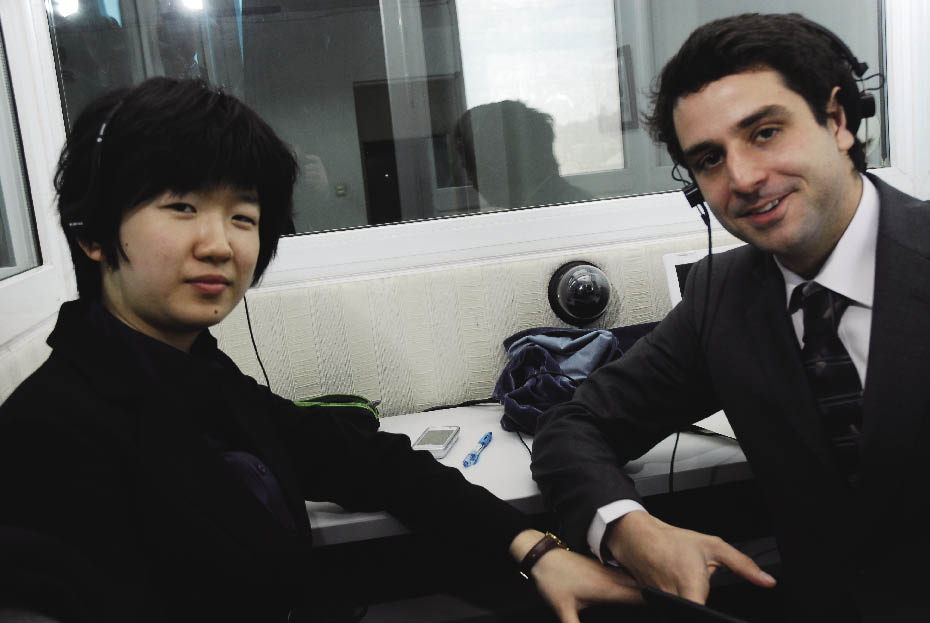 Jonathan Rechtman joins colleague Jin Lu, both perfecting their sequential translation skills at a mock conference.
Jonathan Rechtman is an interpreter. These are oral translators who have to work on their feet. Of the language-bridge lot, interpreters have the toughest job, often doing the most sensitive work under pressure. They are as rare as hen's teeth. Therein lies the worry: he anticipates a China that will need many more of his kind for an explosion of points of communication on every industrial, academic, and political horizon. There's many a slip twixt the cup and the lip as Shakespeare said, and Rechtman and his peers would like to limit those misunderstandings. Sadly, Jonathan is one of the last of a class of students benefiting from a scholarship provided by the EU's Directorate General of Interpretation, a fund run in conjunction with the University of International Business and Economics (UIBE).
|