Adventures in “Big Charity”
The aftermath of spectacular success is often a look back over the shoulder, and Chinese entrepreneurs-cum-philanthropists are busy trying to give back to their societies. As it turns out, corporations are discovering philanthropy is a lot more complicated than they thought. When life was simple, the donor could see where the donation went. When donors and benefactors rubbed elbows, good was done, and seen to be done. But these are the days of “big charity” – the needs may be great or small, or the beneficiaries far or near, but the management of foundations is complicated now; it isn’t easy to follow the money and it isn’t all about money anymore.
The Phianthropy Foundation regulations were passed in 2004. China is relatively new at the game as it’s played today, but the responsibilities are great: Dou Yupei, Minister of Civil Affairs, points out that in the huge transition being made in Chinese society, the onus for providing many social services are now transferred to charities and NGOs, sometimes referred to as “corporate socialism.” China’s benevolent classes didn’t need a push; they went to work, and within the last two to three years have formed an impressive number of foundations for charitable giving: 991 pubic funds and 846 private foundations. And it is the private foundations that are growing at a rate of speed that leaves a kind of social vacuum in their wake. Money used to be the focal commodity of the “social capital marketplace”; donors were “suppliers” of cash, and the nonprofits were “demanders” of their funds. Wealthy Chinese companies embracing their social obligations could simply go off and “do good works” in the name of their enterprises, either through these bodies or not. Many still do. It seems there’s many a slip twixt the cup and the lip however.
 |
|
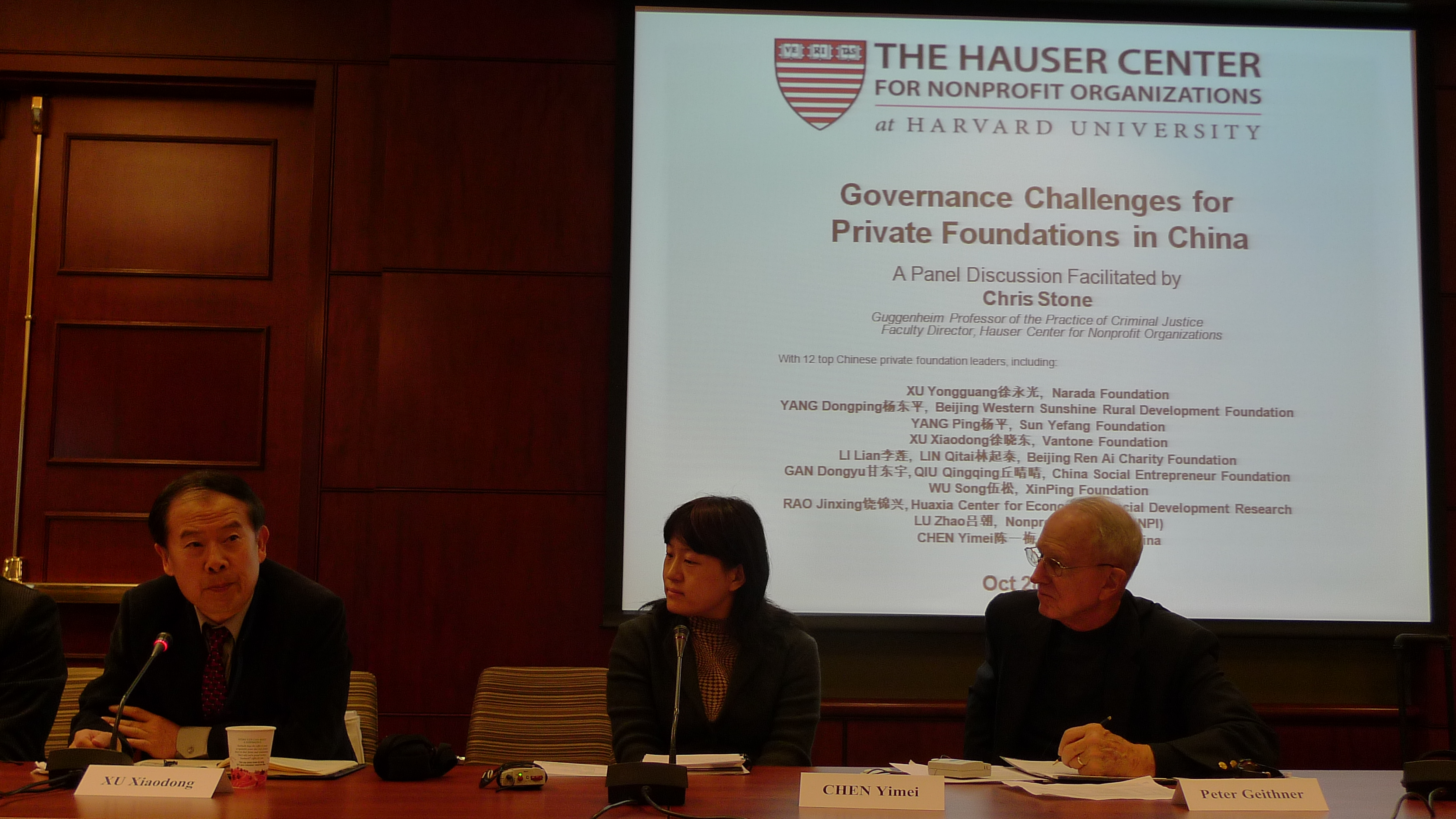
The “grandfather” class of American philanthropy mounted a conference at Harvard University specifically for their Chinese counterparts. |
The soft skills and executive talent needed to manage a charitable foundation or NGO may be the same smarts used to run a business, and at the same time, different. To complicate matters, the mechanics of intelligent giving have been evolving; there are many hands reaching out for limited help. The proper implementation of laws governing funds and foundations may be lagging behind their actual intent, Xu Yongguang, Secretary General of the Narada Foundation, points out, and today’s charities need an unambiguous relationship with taxation relief laws. Nevertheless, the Narada Foundation, a veteran Chinese charity, led the charge with the likes of foreign “old hands” Mercy Corps and the Ford Foundation (USA) who have their own operations in China. Together they cleared a path for a few high profile companies who followed suit; SOHO, New Oriental and others in China – the “new philanthropists,” let’s call them – decided to pool their resources to sort out important questions related to their own giving.
When Kindheartedness Isn’t Enough
Effective philanthropy looks a lot like running a business, so they addressed it as such. There are issues and challenges involved – regulations, public relations… there are even “markets.” Building corporate competency for managing a charitable fund calls on many skills, and certain kinds of knowledge that may be new to business executives. Criteria and processes exist to help wealthy and generous enterprises answer critical questions related to the “fit” of their charitable profile with their business image. Or so the new philanthropists learned when they self-organized under the moniker the “Educational Roundtable”; this group met monthly, hosted by the Ford Foundation and facilitated by American and long-time China consultant Sabina Brady. They ruminated on how you go about deciding what you want to do for society as an organization. If your business is real estate or test-taking, they pondered, does that influence where you step up? Making better decisions about how to allocate their resources and how to demonstrate internal value for their social “missions” simply made good business sense too.
After sorting out the identity and branding questions, it didn’t get much less difficult though. Once established, corporations increasingly want, and are under pressure, to identify and measure the social and business impact of their giving. It’s relatively pricey to launch a foundation, and efforts can go sideways. There are cases of well-meaning donors providing funding for completely unsuitable “improvements” in less developed regions of China whose infrastructure realities they haven’t grasped. Meanwhile, the threshold for establishing a foundation is fairly high, anywhere from 2 to 10 million RMB. For a corporation, these are unlikely to be serious obstacles however, especially for organizations seeking the tax benefits – another aspect of formal charity that ports well from the West to the East.
In countries with long and established traditions of philanthropy, the governance of corporate charitable funds is much more outcomes-driven, and results-focused; it’s normal for giving to be considered an investment and returns expected. If that seems cold and business-like, consider that following a company’s decision about mission and fit, there are many areas that require attention to subsequent policy: fund-raising practices, disclosure, transparency to government regulators, donors and the public, accommodation of non-cash donations or donor-advised funds which are earmarked for specific projects, and, in the sophisticated stratosphere of mature, well-run funds, issues like identifying conflict of interest, and encouragement and protection for whistleblowers call for the corporation’s attention.
|