| Ethnic Qiang Culture Survives Earthquake
By staff reporter ZHANG HUA
MA Jihui, 41, is bent over a piece of embroidery in front of her tent. In the distance behind her loom the ruins of a village – Luobozhai, home to her and hundreds of other Qiang families before the 2008 Wenchuan earthquake. Dense cherry trees encircling the area have come into full bloom, heralding spring and foretelling a fruitful summer. Beyond them is a lotus-shaped, snowcapped mountain veiled in fluffy clouds.
The village, which is 20 kilometers from the seat of Wenchuan County, marks the site of the Qiang Kingdom's capital of 5,000 years ago, and boasts the largest cluster of Qiang buildings in the Qiang-inhabited area. Their walls are a mixture of mud, cobble and jute, and their construction a product of time-honored craft rather than modern tools and design. To defend it from invaders, the village was laid out like a huge labyrinth in which all houses were arranged to facilitate the withdrawal and concealment of its residents. Unfortunately, this masterpiece of architectural genius and cultural richness didn't entirely escape the massive destruction of the May 12 earthquake last year.
Even today Ma Jihui still shudders at the memory of that dark day. "I was back from the field at noon, and about to feed the pigs. I had barely reached the sty when I heard a strange sound coming from the mountains, then noticed the sky dim. A few seconds later my two-story house cracked in the middle, seemed to heal again, then suddenly toppled down. Its front gate catapulted over me, stunning me out of my state of fear and confusion. I dashed out of the yard, following my neighbors in a headlong run down the mountain." Her community of 1,080 lost 42 people, including seven children and 15 elders, one of the highest tolls in Wenchuan County. Eighty-five people were injured.
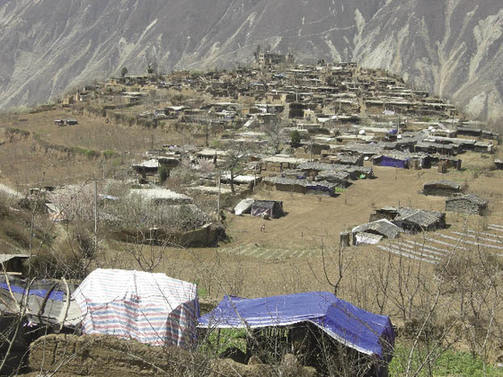 |
| Luobozhai Village in ruins after being devastated by the earthquake. |
A New Life for Qiang Embroidery
Compared with many of her neighbors, Ma Jihui was twice lucky: none of the dozen members of her family was hurt in the earthquake, and her livelihood from expert needlework skills was soon restored. Like other Qiang women, Ma was taught embroidery by her mother; since the age of four or five she has practiced it, decorating every piece of her family's cloth housewares. Remembering her mother's wish to keep the Qiang tradition alive, Ma made sure she passed the handiwork skill down the family line. Her daughter, now 14, can make a nice piece independently. After the quake, when she and other students in the village moved to a school in another township, she carried needles and threads with her. According to Ma Jihui, girls of her daughter's age make better embroideries than the older generation. They learn painting at class, and then apply it to their needlework, introducing new patterns into the repertoire perfected by old methods. "When I attend school activities, I am proud to see works by my daughter and her classmates on display in the doorway," said Ma.
Sadly, a loss Ma Jihui still frets over is her centuries-old loom, which did not survive the quake. Qiang embroidery has always been done on flax fabric produced by locally-made looms. Seeing no hope of retrieving her antique, she finally collapsed into tears amid the debris. An aid worker from Jiangmen City, Guangdong Province, tried to comfort her, promising a new loom. Ma replied in gratitude, and some embarrassment, "You have given us a lot. We shouldn't depend on Guangdong and the government for everything." Stepping up in a bigger way to salvage Qiang culture, film star Jet Li's One Foundation established aid stations in Sichuan in August 2008. Its staff brought cloth, thread and designs to the local women, paying them RMB 8 for each pattern embroidered. Previously Qiang women had made decent earnings selling embroidery works to visitors to the region, so with the disruption of tourism after the quake, the foundation's offer was not only a welcome source of income, but a fount of strong moral support as well.
|